
119 — October 2026
Performing Environmentalism, the Climate Generation, and the Politics of Hope
Jane Chin Davidson
A critical genealogy of environmentalism in performance art, presented globally since the 1960s and 1970s, can be traced through the environmental restorations and diverse advocacies of eco-art, eco-feminist art, earth art, and performing landscapes (works sited in the landscape). While the ideologies of eco-artists often diverge, their ecological and sited events coalesce around environmental activism and advocacy, although the ideals of eco-feminism are often cited as oppositional to the phallic gestures of land art.1 While the generational dimension of the environmental crisis brings this study into the urgent present of global warming, marked by the prevalence of natural disasters – wildfires, hurricanes, floods –, it also calls for a pedagogy oriented toward the Climate Generation, consisting of the post-millenial Gen Z or iGen, born after the 1990s and considered as the first generation to spend an entire lifetime under the impact of climate change.2 This periodization has also been linked to the “human-dominated geological epoch”, which establishes the scientific definition of the human-caused crisis recognized by scientist Paul Crutzen as the Anthropocene’s “geology of mankind”.3 The Climate Generation not only bears the responsibility of the rapid demise of the planet, now attributed solely to the human species, but must also carry the anxiety about the future and the emotional labor of confronting what to do with our fossil-fueled, capitalist lifestyle, the redoubtable cause of environmental destruction. In respect of the implicit demands placed on this generation of students, what is the responsibility of the academy when such a duty is rarely connected to art or art history? Could a different, innovative pedagogy possibly make a difference in the lives of the Climate Generation? To this end, the following analysis of environmental performances draws on the theory of the Capitalocene as a rewriting of the Anthropocene, which attributes the beginning of crisis and annihilation for both humans and the environment to fifteenth-century colonialist capitalism. Based on the Capitalocene timeline, the scene of disaster has already been captured by the loss of entire human-nonhuman populations, if one acknowledges the long history of colonialist genocide against First Nations.
In the twenty-first century, the nuclear catastrophe in Japan exemplifies the new disaster nexus within the present environmental emergency, warranting the fear and anxiety experienced by the Climate Generation. Ultimately, however, this essay questions how a critical genealogy of environmental performances could foster encouragement and hope through the arts, even within the necropolitical conditions of “unnatural” catastrophes. My exploration of environmental performances, such as those by Japanese artist Ichi Ikeda, is based on the ways in which they address environmental disaster in both culturally local and global ways. In this context, Ikeda has promoted the concept of humanity’s “primary relation” to water since the 1980s, but his message only became fully comprehensible decades later in the aftermath of the Fukushima nuclear accidents.4 The artist explains that he began his career as a scientist in chemistry, where his study of radiation-induced polymerization led to an unanticipated explosion. His subsequent fear of the ability to control or anticipate chemical reactions would be confirmed many years later by the 2011 Fukushima Daiichi Nuclear Plant disaster, resulting from the Tōhoku earthquake and tsunami. The nuclear disaster strengthened his resolve to work with community members to find courage, strength, and hope by creating environmental performances such as 5 Greenscapes Shinobazu (2012). I am inquiring in this essay whether an art-as-environmental-humanities approach to crisis can be discerned in ecological art practices that seek to advocate for change, especially in the aftermath of disasters like Fukushima’s. An activist pedagogy engenders the possibility of radical hope for the Climate Generation by reconnecting humans with nature and by engaging performance as a medium for alternative emotional and sensory experiences.
Decolonizing the Modernist Ideologies of Colonialist Capitalism
The separation of culture from nature played an important role in the Western Enlightenment ideal for a civil society under modern capitalism, grounded in a scientific and rational logic of a division that continues to inform the academic model. While art and art history students continue to engage with a vocabulary of artistic avant-gardism, it is rarely connected to the underlying “civilizing” ideal of artistic progressivism. A critical genealogy of environmental performance showcases artists who have challenged this nature/culture divide through environmental actions that, I argue, can function as anti-capitalist and anti-colonialist endeavors.
A decolonizing pedagogy, as such, requires cognizance of the false assumptions that perpetuate the neo-colonialist belief in the capitalist goals of modernity and its so-called civilizing mission as a legitimizing rationale for colonization by any culture, including the Spanish conquest of sixteenth-century Mexico. The tacit rhetoric of modernism as well as the separation of the primitive from the progressive, reinscribes the colonialist ideology of history. The civilized and modern became inextricably linked to manufacturing, trade and profit – a logic defined by Adam Smith in The Wealth of Nations (1776), where he writes that economic prosperity within civil society is
so great, that all are often abundantly supplied; and a workman, even of the lowest and poorest order, if he is frugal and industrious, may enjoy a greater share of the necessaries and conveniences of life than it is possible for any savage to acquire.5
The figure of the “savage” had long represented the uncivilized and primitive peoples outside of capitalism who, from 1450 to 1650, were not only enslaved as a consequence of Dutch, Portuguese, and Spanish explorations, but also experienced the catastrophic dispossession of their lands and resources across the Americas, Asia, and Africa, all in the name of modernization and civilization.
According to Jason W. Moore, industrial humanity was not a product of nineteenth-century industrialization, which some accounts of the Anthropocene identify as the beginning of large-scale human intervention in the environment, but rather the outcome of the fifteenth-century inception of profit and capitalism through colonialism’s appropriation of cheap nature and cheap labor. Colonization initiated a profound and lasting transformation of both human and planetary ecologies. As Moore writes, “most humans were part of Nature and this designation worked through the new divisions of labor. An African slave was not part of Society in the new capitalist order.”6 From this point onwards, the human species was divided along binary oppositions, such as the savage and the civilized, the primitive and the modern, patriarchal order and cycles of mother earth, which ultimately established the divide between nature and culture.
Going by the Capitalocene timeline, Moore agrees with Donna Haraway’s opposition to the Anthropocene’s identification of the “human” as inclusive of all individuals on the planet. Instead, Haraway problematizes the category of the “Anthropos”, arguing that “fossil-fuel-burning humanity doesn’t even speak to all of industrial humanity, but specifically the formations of global capital and global state socialisms.”7 Rethinking life in the age of capital, the term Capitalocene recognizes the myopic focus of capitalist modernity, which privileges only certain human relations while marginalizing others within Adam Smith’s model of civil society. The Capitalocene thus foregrounds how capitalism has reorganized the conditions under which all forms of life circulate, while highlighting how the wealth-holding class of civil society’s high-consuming lives are different from other humans living in the so-called developing countries. It’s also important to note that critics of the Anthropocene argue that Crutzen and Eugene Stormer inexplicably turn to scientific and technological advancements as solutions to the environmental crisis, produced by the very industrial-capitalist system they critique.8
Performing Trees
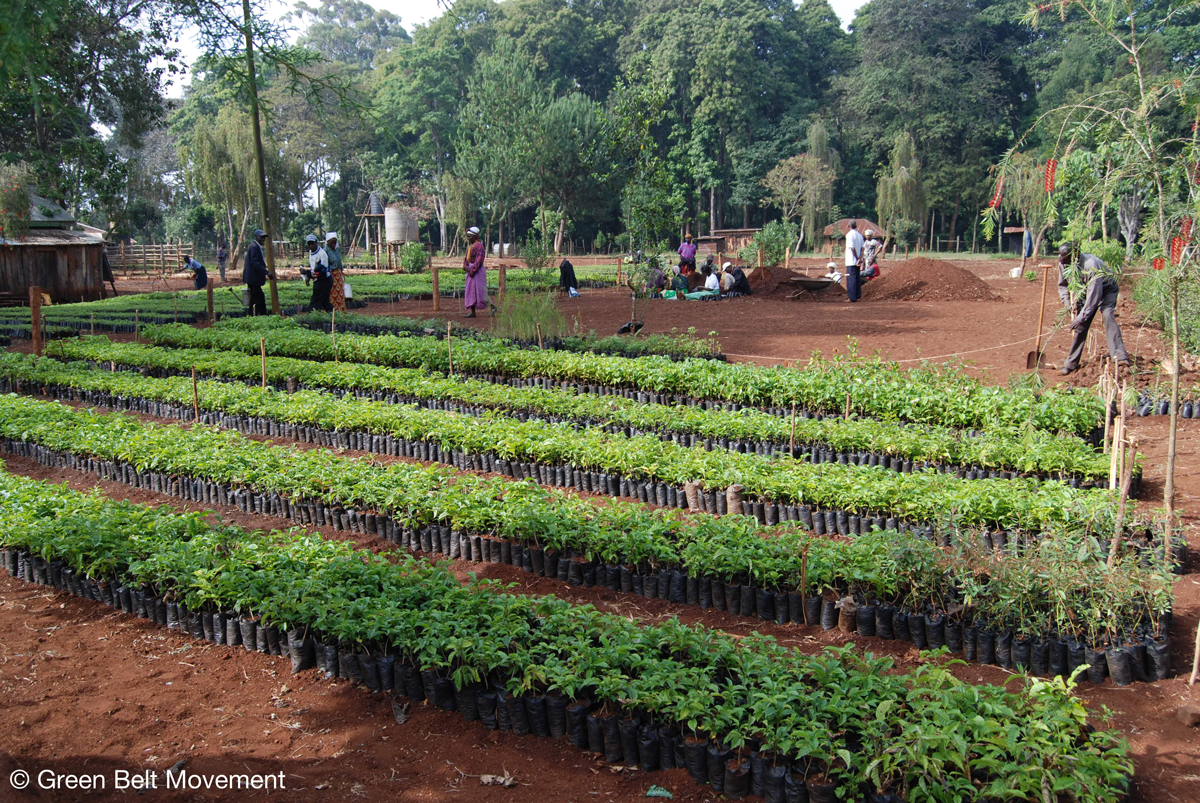
Since the 1970s, many environmental artists have sought alternatives to industrial modernity by turning toward nature, ancestral or cosmological knowledges, and thereby rejecting the colonialist assumptions of the “primitive” and the “uncivilized”. The activism of Wangari Maathai is exemplary of indigenous rather than industrial solutions to environmental problems today. Her life’s work in Kenya constitutes an emblematic example of persistence within a politics of hope. Maathai began her tree-planting initiative in 1976, a famously successful “global movement” that inspired artist Rasheed Araeen to extol her significant influence: “millions of trees have since been planted – and are still being planted every day – all over the world.”9 Maathai was awarded the 2004 Nobel Peace Prize for her Green Belt Movement (Fig. 1), in recognition of its contribution to “sustainable development, democracy and peace”.10 The Nobel website proclaimed that she was the “first African woman to receive the Nobel Peace Prize. She was also the first female scholar from East and Central Africa to take a doctorate (in biology), and the first female professor ever in her home country of Kenya.”11 Best known for mobilizing the Kenyan community to act on behalf of trees, her opposition to deforestation was political, challenging the colonization of the forests, cleared by commercial developers in collaboration with the Kenyan elite, including the profiteering regime of President Daniel arap Moi. Accused of being a woman who did not “know her place”, Maathai was beaten and arrested multiple times, yet her Green Belt Movement flourished, growing from a network of 600 community groups that established 6000 tree nurseries. Her vision continues to this day across continents and cultures, and her initiatives were rooted in her advocacy for Kenyan women who became farmers in the poorest rural areas.
Maathai, who died in 2011, envisioned tree planting as an action for building a broader global framework, connecting women’s rights to democratic participation worldwide. Her obituary attributes her “remarkable academic rise to become the first woman to run a university department in Kenya [at the University of Nairobi] […] entirely to her closeness to nature. It was the land that showed her and taught her everything, she said.”12 Nothing could explain better the life-affirming breadth of her project than the symbiotic existentialism of Maathai’s human relationship with trees, nature, and her environment. Most importantly, she embodied the extraordinary example of an academic who took an eco-feminist stand, whose radical pedagogy actively challenged the industrial commodification of the trees, the forests, and thus, defended her homeland.
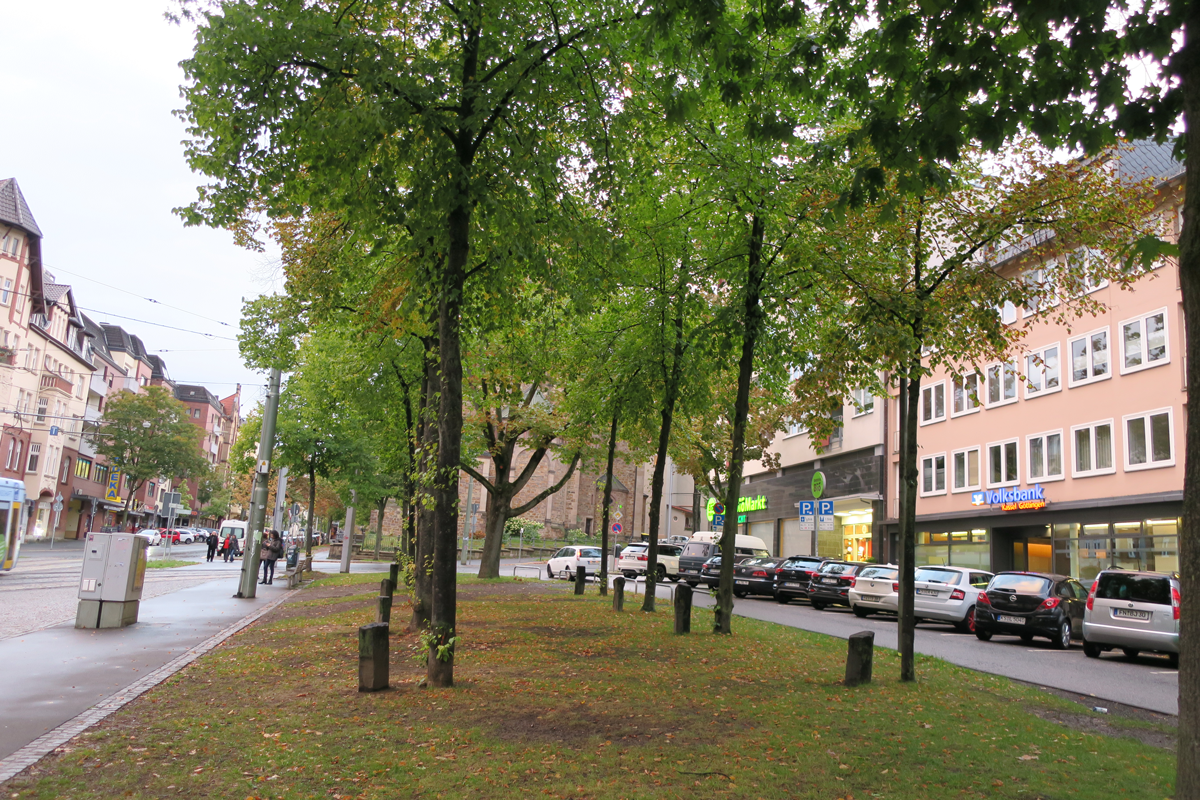
Artists working in environmental performance share the important goal of ecological regeneration as modeled by activists such as Maathai. The most prominent example is Joseph Beuys’s ambitious 1982 performative project 7000 Eichen (7000 Oaks), initiated at the site of the Friedericanum Museum for documenta 7 and extended throughout the city of Kassel. Not unlike the communal implementation of the Green Belt Movement, the monumental task was successfully completed by 2500 Kassel residents, schools, local and neighborhood councils working together (Fig. 2). For Rasheed Araeen, however, the context of the museum underscores a crucial difference. Beuys’s tree-planting project was exhibited as an artwork representing the institution of documenta for a five-year period, rather than undertaken solely for the political cause of “sustainable development, democracy, and peace”. Araeen argues that unlike Maathai, who was working as a woman under the patriarchal violence of state domination, Beuys did not put his life on the line. Araeen explicitly acknowledges this difference, arguing that whereas Beuys represents “art in its allegoric cocoon, institutionally legitimized as an achievement of the individual genius”, Maathai’s work “enters life and becomes part of its collective dynamics.”13 He further traces these collective dynamics through the educational trajectories of Maathai and Barack Obama, Sr., the Kenyan father of the U.S. President. Both received Kennedy Scholarships to study in the United States during the 1960s period leading up to the independence of their Kenyan homeland from British colonial rule. By highlighting the shared consciousness connecting Obama and Maathai, and thus “Africa with the Americas”, Araeen argues that Maathai liberated creative agency from Beuys’s “institutional enclave” on behalf of “a vision that wants to change the world for the betterment of all life on earth… It is this vision that we now need in art.”14 Maathai’s transformation of the so-called civilizing mission is evident in the way she mobilized academic knowledge for social and environmental change. As a professor at the University of Nairobi and later head of her department, she elevated agrarian knowledge beyond the university, transforming it into the foundation of a global environmental movement. Her activist pedagogy was thus inseparable from her academic leadership.
Many indigenous artists have innovated the performance event to create unique kinds of contemporary art exhibitions. I have written about likeminded initiatives elsewhere, including the 2018 multi-layered two-day performance, Cherry River, Where the Rivers Mix,15 conceived by artist Mary Ellen Strom and Crow member and First Nations scholar Shane Doyle. Presented on the banks of the river at Missouri Headwaters State Park in Montana, the event brought together diverse communities through a site-specific engagement with Indigenous history and ecology. Not unlike the broader movement to restore precolonial place names to landscapes and monuments across the United States, the Cherry River event was centered on renaming the East Gallatin River back to Cherry River, Baáchuuaashe in Crow, the name long used for the river by many Native American communities living in the Three Forks region. The performances reflect the inextricable relationship between humans and nature, representing the ecological priorities of Indigenous ideals.
However, these works also exemplify the conceptualism of contemporary art: through the language of performative gestures and embodied actions, they reconnect participants to the exhibition’s location and site. In this respect, they resonate with the legacy of Minimalism, Land Art, and site-specific performance practices that emerged in the 1960s. These movements expanded the fields of sculpture and performance by privileging embodied experience of place over engagement with autonomous art objects. Other artists from this genealogy of sited performances similarly emphasize social action while recognizing sublime nature. Among them is Wu Mali in Taiwan, whose Plum Tree Creek project (subtitled Mending the Broken Land with Water) began in 2009 when she learned from a local historian that the Plum Tree Creek, a dirty and polluted tributary of the Danshui River, had once been a flourishing clean stream.16 Active as a conceptual video and installation artist since the 1970s, Wu Mali extended her long-standing performative practice into environmental activism through this project.
Functioning as a type of political activism since the 1960s, performance art shares affinities with feminist/queer/critical race initiatives in challenging entrenched relations of power. Ecofeminist critics such as Carolyn Merchant and Val Plumwood have argued that the human domination of nature emerges from aggressions of patriarchal power, much in the way that Maathai had to endure violence as a woman activist in Kenya because she was the leader of the Green Belt Movement. By the late twentieth century, however, many feminist theorists criticized the tendency to essentialize the relationship between women and nature by assuming that “nature” determines sex or gender. Judith Butler’s influential account of gender as a social and performative construction became central to these critiques.
Still, the feminist counter to ecological violence continued to reconceptualize “reproduction” in expansive terms, encompassing restoration, renewal, and the rebirth of all biological human and earthly life. Dominique Mazeaud’s extended performance The Great Cleansing of the Rio Grande (1987-1994), a meditative journey to clean the Sante Fe River, and Shai Zakai’s Concrete Creek (1999-2002), which cleared a polluted dumping ground in Israel’s Ella Valley, exemplify this regenerative activism within contemporary performance art.17 There is no question, however, that their performances produced tangible environmental impacts that extended well beyond their status as works of art or exhibitions.
Conceptualist Water
Artist Ichi Ikeda is a water activist whose artistic practice has, since the 1980s, centered on water justice, conservation and renewal in Japan and in other places around the world. Water functions for Ikeda as subject, material, medium, and concept. Creating large and small-scale sculptural performances – such as 80 Liter Water Box, presented at Japan’s Third World Water Forum in March 2003 –, Ikeda says he aims “to create symbiotic relationships through actions and to develop my artistic activities with water.”18 80 Liter Water Box visualized the estimated 80 liters of water required daily to meet a person’s needs, while drawing attention to the stark inequalities in global water access. At the time, nearly three quarters of the world’s population had access to 50 liters or less per day. In Maathai’s Kenya, for instance, the average daily water availability is only five liters per person, whereas “some people in the West use 1000 liters of water per day just watering their lawns and washing their cars.”19 Ikeda’s form of advocacy engages the community as both audiences and participants, sharing mutual environmental objectives and strategies with Wu Mali, Mary Ellen Strom, and Shane Doyle.
In particular, Ikeda’s work expresses the symbiotic relationship between humans, water and nature while also illustrating the complexities of art-historical epistemologies, including Japan’s distinctive global avant-garde trajectory. These complexities are especially evident in relation to Japan’s history of colonialism, which is often subsumed by narratives of Japan’s World War II imperialism. This includes the annexation of the indigenous Ryūkyū territory (present-day Okinawa) as well as the occupation of the Ainu territory by Japanese settlers of Hokkaido. Ikeda’s artistic actions are thus imbued with specific historical and political meanings, but what’s often left unacknowledged are the colonialist power structures that have shaped the genealogies of performance itself. It would be erroneous to reduce Ikeda’s water activism to simply a global aesthetic. Rather, his practice emerges from the legacies of postwar Japan, where the violence of wartime imperialism and the enduring trauma of the atomic bombings of Hiroshima and Nagasaki continue to shape cultural memory. Representing his community in Japan, Ikeda’s environmental performances express an epistemic politics of radical hope for the generations that have come after 1945. At the same time, Japan’s nuclear history is not only a national legacy but also a planetary concern for the global community, underscoring the shared responsibility to confront ongoing environmental disasters that affect all of life on the planet.
Nuclear Dread
Artist Yoshihara Jiro’s 1956 Ruins from Mukogawa River, performed near Amagasaki, Japan, represents the famous Gutai group’s explorations in the aftermath of the nuclear holocaust of atomic bombs dropped by the U.S. military on Hiroshima and Nagasaki in 1945. Against the backdrop of an apocalyptic disaster that affected humans and the environment alike, Yoshihara situated his own body in contrast to the river landscape to confront the cultural and material ruins of postwar Japan. As the author of the Gutai Manifesto, he sought to challenge what he described as the “dead” art of imperial Japan. Since then, Gutai has been given a prominent place in Western histories of performance art as scholars have confirmed the group’s contribution to global contemporary conceptualism and twentieth-century avant-gardism.
It should be noted that Gutai’s performances and events in 1950s-60s Japan represented anti-war actions directed specifically against the horrors experienced by the Japanese people. Rejecting traditionalism and Japan’s imperialist past, Gutai looked optimistically toward future possibilities for art through experimenting with technology. Members such as Yoshida Minoru created performance sculptures with electric sound devices to acknowledge Japan’s post-war recovery. By 1970, however, a new generation of performance artists, including the Kyoto-based collective Banpaku Hakai (Destruction Joint-Struggle Group), had begun to challenge the industrial empire that emerged in the rebuilding of Japan, including the brand new Tsuruga Nuclear Plant. Banpaku’s dissident performances rejected technological progress as inseparable from industrialization and capitalism, during a period when Gutai was becoming increasingly associated with what came to be known as “kankyõ geijutsu (Environment Art)”, a term that by “the late 1960s [referred] to spectacles deploying advanced technologies of sound, motion, light, and film.”20 Dalai Jee recounts how the Banpaku artists denounced the “foolishly optimistic quest of technology in art”, as they took their demonstrations into the streets and created morbid scenes by stacking their bodies to dramatic effect.21 Their teach-ins and protests would also involve anti-Vietnam-war resistance. Foreseeing the dangers of Japan’s expanding nuclear-energy program decades before the Fukushima disaster, many artists expressed what later came to be known as kaku no kyōfu (“nuclear dread”), acknowledging the threat that nuclear technologies posed to both humanity and the environment.22
Since 1997, artist Kenji Yanobe performed this “nuclear dread” in his iconic protective Atom Suit, a fully functional hazmat gear replete with a radiation-detecting Geiger counter. He first donned the suit at the ghost town of Pripyat near Chernobyl after the 1986 nuclear reactor meltdown; his artistic objective at the time was to question whether humans could really protect themselves from atomic annihilation. By placing his human body in the ruins of Chernobyl’s environmental disaster, he provoked the memory of the devastated landscapes of Hiroshima and Nagasaki while eerily foretelling the 2011 scene of the nuclear meltdown in Fukushima. The Atom Suit persona was a nod to a 1950s-60s childhood figure: the Manga character Tetsuwan-Atomu or “Atom Boy,” created by graphic artist Osamu Tezuka. Yanobe represented this memory in his return to Chernobyl’s nursery school and ferris wheel fairgrounds. In the haunting performance Atom Suit Project: Bumper Car (1997), staged among the rusting children’s rides, the artist mourns the loss of childhood innocence and joy in the aftermath of nuclear crisis.
Yanobe retired the atom suit in 2003, but following the Fukushima accident in 2011, he recreated the image as a twenty-foot statue, conceived as a special memorial symbolizing a “world free of nuclear disaster”.23 Titled the Sun Child, the figure holds his helmet by his side to show he can breathe the air freely. In 2018, Yanobe donated Sun Child to the city of Fukushima and installed it in front of a children’s center. Less than a month later, however, the city announced that the sculpture would be removed due to the upsettingly bad memories and emotions that the statue evoked among people in the community. Rather than symbolizing optimism for the future, it was a reminder of Fukushima’s nuclear disaster, the worst of its kind since Chernobyl. The statue and the performance resulted in different interpretations. When Yanobe performed in his Atom Suit, he was able to connect with the community’s fear and anxiety on a human-to-human scale, whereas the huge statue of the Sun Child signified an immovable monument that many residents experienced as the remembrance of nuclear catastrophe. People had not recovered from the disaster. Rather than creating statues to memorialize disaster, environmental performances function cathartically by confronting the difficult emotions that remain embodied in human memory.
The Dharma Wheel of Hope
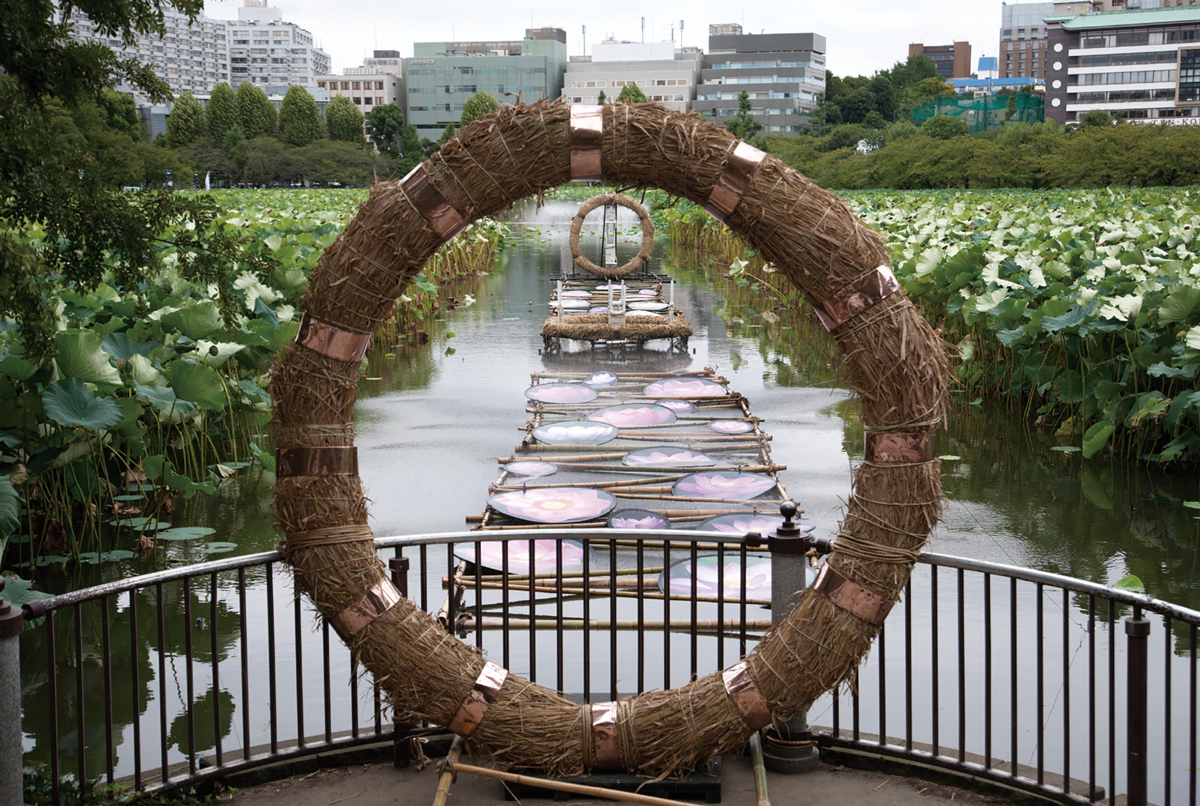
Ichi Ikeda’s 2012 performative installation, the 5 Greenscapes project in Tokyo, offered a vastly different form of memorialization. In the year directly following the 2011 tsunami and the Fukushima nuclear accident, Ikeda brought together 500 participants to create his Greenscapes in Shinobazu Pond, Ueno Park, a well-known tourist spot in the middle of Tokyo.24 Among the Greenscapes project’s central works was Wheel of Hope (Fig. 3), comprising three life-sized vertical rings made from reeds grown in the area. Through what Ikeda described as “Waterway viewing”, Wheel of Hope created an extended, kaleidoscopic perspective across the green pond, once filled with “empty cans discarded, a few remnants of bicycles, branded bags, laptops, and needles.” “The lotus-covered pond” had become “a carefree garbage dump where no complaints are received.”25 The community performers led by Ikeda renewed and reshaped the entire pond to clear the water of suffocating lotus and to create four “water paths”, each envisioning a different landscape.
Ikeda explains how the title Wheel of Hope reflects a comment by a participant who “saw the Pure Land in the misty world that rises up ahead of what I desire. In the midst of the deepening confusion in the world, perspectives toward the light appear like the hopes of each person.”26 Invoking the dharma wheel, Buddhist sutras (as conceived in Japan) recognize the Pure Land’s “world of another dimension”, as the experience of life in the now, in the present, but viewed from the perspective of the next life to come.27 This hopeful viewpoint through the Wheel of Hope emerged from Ikeda’s effort to reconnect communities in the aftermath of the Fukushima tragedy, recognizing how greenscapes could engage humans in an embodied communal action – not to mention that scientists have documented that “green space functions to reduce air pollutants, to reduce temperatures, and to improve rainfall types”, which greatly affects global warming.28 As discussed earlier, the artist is known for his 1990s explorations involving the human’s “primary relations to water”; he has long advocated for people to “realize that water, source of our lives, is the medium to move beyond borders, everyday customs, histories and cultures, in order to realize the profound exchange between human beings and environment.”29
The decolonizing exchange expressed by environmental performance can offer radical hope through non-commodity-based experiences that foster emotionality and a sense of community. Such embodied engagement problematizes the way in which materialist objectification is all-consuming in everyday life; the dynamic sense of human connection with each other and with the local landscape changes our technologically mediated perspective. Ikeda’s Wheel of Hope provides a focal point through the ocular lens of reeds, stretching out across Shinobazu Pond and Ueno Park; through this kaleidoscopic encounter with the landscape, viewers experience nature not as a passive object of observation but as an active participant in sensory and emotional exchange. Only nature can create this emotional engagement, one that resonates poignantly in our time of environmental disasters. Through a Buddhist inflection of hope, Ikeda acknowledges the personal impact of the nuclear accident that had
broken down the community and divided each of us into individuals according to their position and environment… Inevitably, dreams become more diverse. Therefore, the ‘landscape of hope’ becomes a diverse and complex system in which each of us sees our own hopes. It is a complex world of water, light, lotus flowers, and wild birds etc. Unlike the static and monolithic values presented by paintings and sculptures, it emerges as a slowly changing dynamic. Hope is like a living thing, releasing a new life force. It is on a journey through time, wandering in a kaleidoscope to find each own dream. Each person collects fragments of hope that appear in complex systems and unravel his/her own world of hope. In this sense, we can say that it is the hope of each of us within hope.30
Fukushima’s crisis illustrates the high stakes of maintaining the hyper-capitalist industrial lifestyle in the Anthropocene’s third great age of carbon. Scientists Paul Crutzen and Eugene Stoermer devised the geological epoch to implicate all humans in the urgent demise of the planet, even while the greater scientific community did not formally comply with their periodization.31 As humans continue to pursue high-energy-consuming materialist lifestyles, it bears reiterating that the divide between nature and culture was a product of the founding moment in capitalism when the ontological status imposed upon colonized populations was first deemed “primitive’ and “uncivilized”. The wealth-holding “class” of industrial humanity was established to the exclusion and detriment of other humans, the peoples under occupation along with those made into the enslaved and “primitives”. The important point is that this inexorable human disaster was also an environmental disaster.
The book Radical Hope by Jonathan Lear examines the deepest state of despair through the historical figure of Plenty Coups, the last great chief of the Crow in Montana: “when the buffalo went away the hearts of my people fell to the ground, and they could not lift them again. After this nothing happened. There was little singing anywhere.”32 To Lear, Plenty Coups represents radical hope, because he “never abandoned the idea that he had been given a vision that derived from the spiritual world”, even when white settlers broke land treaties and infected his community with disease.33 The devastating loss of Indigenous life in the United States created by colonization is inseparable from the loss of environmental life under the powers of empire, materialism, and industrial capitalism.
Notes
- 1 The monumental works of Minimalism are largely attributed to a generation of male artists, from Robert Smithson to Michael Heizer.
- 2 See Sarah Jaquette Ray, A Field Guide to Climate Anxiety (Oakland: University of CA Press, 2020), 3.
- 3 Paul J. Crutzen, “Geology of Mankind”, Nature 415 (January 3, 2002), 23.
- 4 Hiroko Shimizu, “Japanese Atomic Age Art: Ichi Ikeda Interview”, WEAD Women Eco Artists Dialog #5, 2012. https://directory.weadartists.org/japanese-anti-nuclear-art-ichi-ikeda-interview
- 5 Adam Smith, An Enquiry into the Nature and Causes of the Wealth of Nations (New York, NY: Random House, 1937), 2.
- 6 Jason W. Moore (ed.), Anthropocene or Capitalocene? Nature, History, and The Crisis of Capitalism (Oakland, CA: PM Press, 2016), 88.
- 7 Donna Haraway and Martha Kenney, “Anthropocene, Capitalocene, Chthulhocene”, in: Heather Davis, Etienne Turpin (eds.), Art in the Anthropocene (London: Open Humanities Press, 2015), 259.
- 8 See Paul J. Crutzen and Eugene F. Stoermer, IGBP Newsletter 41 (2000), 17-18.
- 9 Rasheed Araeen, “Wangari Maathai Africa’s Gift to the World”, Third Text 23.5 (2009), 675.
- 10 https://www.greenbeltmovement.org/what-we-do; see also https://www.nobelprize.org/prizes/peace/2004/maathai/facts/
- 11 Ibid.
- 12 John Vidal, “Wangari Maathai Obituary”, The Guardian (26 Sep 2011).
- 13 Araeen, “Wangari Maathai Africa’s Gift to the World”, 675.
- 14 Ibid.
- 15 See my article “Cherry River: Art, Music, and Indigenous Stakeholders of Water Advocacy in Montana”, Case Studies in the Environment 6.1 (2022).
- 16 See my book chapter “Environment, Labor, and Video: (Eco)feminist Interpellations of Chineseness in the Work of Yuk King Tan, Cao Fei, and Wu Mali”, in: Staging Art and Chineseness: Politics of Trans/Nationalism and Global Expositions (Manchester: University of Manchester Press, 2020), 89-122.
- 17 See also my article “Performance Art, Performativity, and Environmentalism in the Capitalocene”, in: Paula Rabinowitz (ed.), The Oxford Research Encyclopedia of Literature, 2019
- 18 John K. Grande, “Water Mirror: A Conversation with Ichi Ikeda”, Sculpture (Sept. 2007), 22.
- 19 Ibid., 25.
- 20 Kuro DalaiJee, “Performance Art and/as Activism: Expo ‘70 Destruction Joint-Struggle Group”, Review of Japanese Culture and Society 23 (2011), 165.
- 21 Ibid. For more information about Expo 70’s example, see my essay “Biennial as a Discursive Political System for Contemporary Art”, in: Amelia Jones and Jane Chin Davidson (eds.), Contemporary Art in the Global Framework, (London: Wiley Blackwell, 2023), 481-501.
- 22 See Bert Winther-Tamaki, “To Put On A Big Face: The Globalist Stance of Okamoto Taro’s Tower of the Sun for the Japan World Exposition”, Review of Japanese Culture and Society 23 (December 2011).
- 23 Taylor Dafoe, “This Giant Sculpture of a Child in a Hazmat Suit Was Meant to Inspire Hope—Then People Got Creeped Out”, Artnet (August 30, 2018).
- 24 The Greenscapes project was a main program of the National Urban Greenery Fair, organized by the Tokyo Metropolitan Government.
- 25 Ichi Ikeda, Earth Art Manual (Tokyo: TPAF, 2020), 242.
- 26 From correspondence between Ichi Ikeda and the author, December 31, 2021.
- 27 See Fujita Kōtatsu and Rebecca Otowa, “The Origin of the Pure Land”, The Eastern Buddhist 29.1 (Spring 1996).
- 28 Shimizu, “Japanese Atomic Age Art: Ichi Ikeda Interview”.
- 29 Ibid.
- 30 Ikeda, Earth Art Manual,
- 31 The International Union of Geological Sciences (IUGS) officially rejected the new geological dating of the Anthropocene in 2024.
- 32 Jonathan Lear, Radical Hope: Ethics in the Face of Cultural Devastation (Cambridge: Harvard University Press, 2006), 2.
- 33 Ibid.,