
118 — July 2026
Eating Machines.
Transcultural Perspectives on Anthropophagy from Cinema to AI
Hannah Peuker
“I asked a man what Law was. He replied it was a guarantee of the exercise of possibility. That man was called Galli Mathias. I ate him.” — Oswald de Andrade, Anthropophagic Manifesto (1928)
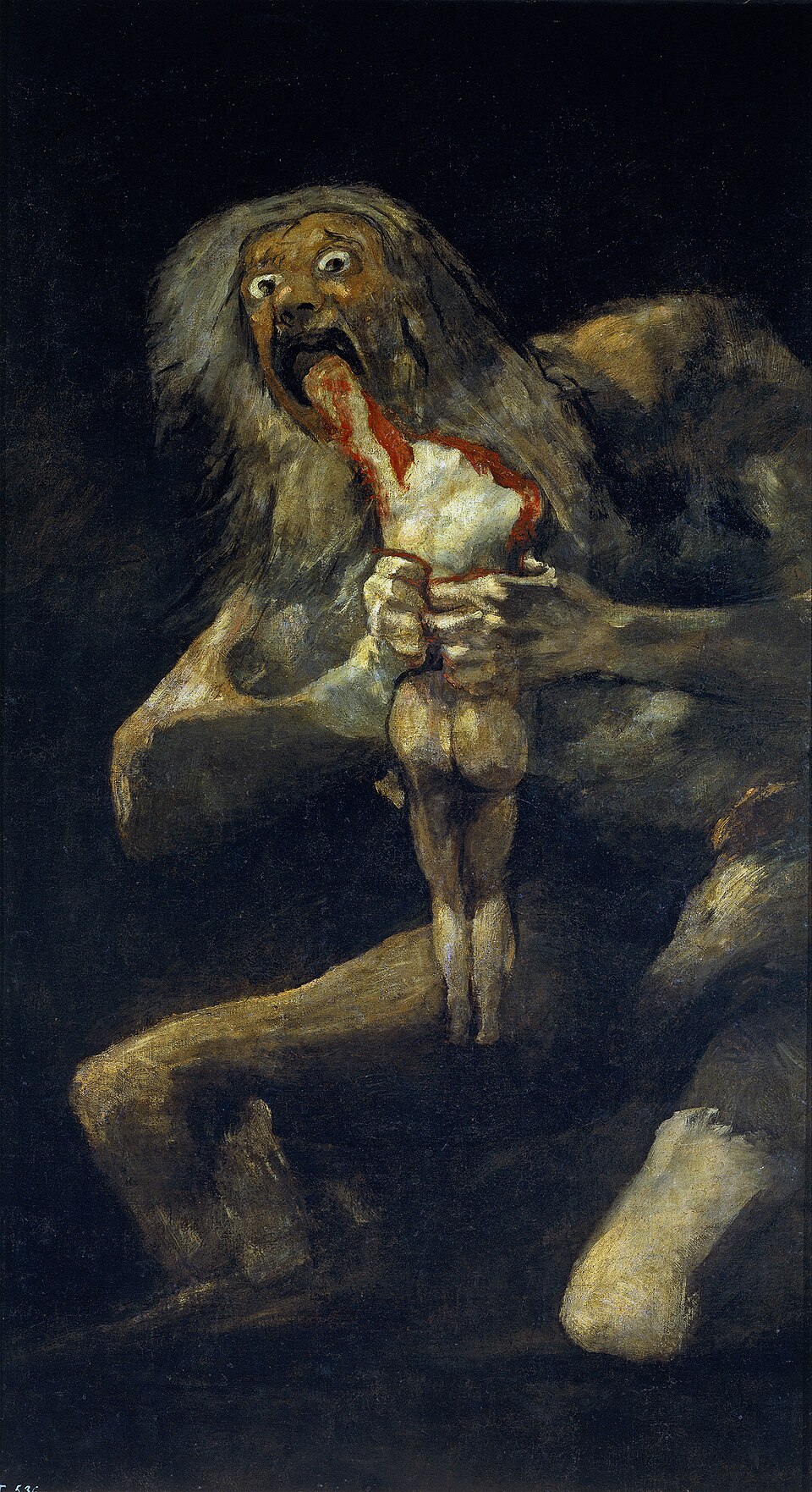
In recent years, a new term has entered public discourse about AI: so-called data cannibalism. The idea behind this neologism is that training AI systems with human-created content has reached a limit. LLMs have been fed with libraries, internet archives, and webpage content to the point that no ‘naturally’ created resources remain. As a result, AI – in an analogy to the Greek father of the gods, Cronus (Fig. 1) – has begun to consume its own offspring: synthetic data will increasingly train existing and new systems. AI researchers, journalists, and bloggers have begun to speculate on the consequences of this tendency. A frequently articulated assumption is that AI data cannibalism can lead to system collapse, as biases and errors from the ‘parent model’ are carried over and amplified in its descendants. As IT consultant Sean Michael Kerner explains: “The offspring models that train, or ‘feed’ on the original model, consuming its outputs, lead to systemic errors in the offspring. Any bias from the original model propagates across all cannibal models trained on the original” (Kerner 2025).1
Yet rather than taking up the debate over whether model collapse due to self-cannibalization is likely, I want to shift perspective toward cannibalism as a symbolically, affectively, and politically charged metaphor. I will ask: which layers of meaning and emotional response does describing AI as cannibalistic media evoke? Which images and narratives about cannibalism from different cultural contexts does the current discussion bring to mind? And what does it say about us that we call our most controversial technology cannibalistic? To address these questions, I first offer a brief introduction to central lines of flight in the cultural history of cannibalism and then turn to anthropophagic cinema. Cinema provides deep insights into our cultural imagery in general and into cannibalism in particular. I analyze filmic cannibalism from diverging cultural contexts to elaborate on the role that cannibalism (especially anthropophagy) plays in the relationship between processes of self-imagination and othering. Against this cinematographic background, I then revisit the question of cannibalism in current AI debates.
1. From Abjection to Subjectification: Anthropophagy as (Post-)Colonial Marker
Anthropophagy – the human form of cannibalism, often understood as its ritualized variant – is a delicate subject. On one hand, we can argue that the cannibal is a figure of extreme otherness. It has been used since early colonial writings to justify excessive violence against those not considered part of the Western definition of civilization. Framing someone as cannibalistic therefore automatically invokes ideas of racial discrimination. Yet the concept of the cannibal shifts from past to present, from culture to culture, from one form of storytelling to the other, from religion to science and back again. At first glance, it might seem inconsistent that the same ‘civilized colonizers’ who depicted Indigenous Peoples as cannibals to justify suppression belonged to a culture deeply rooted in myths of cannibalism. Greek Cronus and later Roman Saturn both began to rule through acts of cannibalism. Eating other gods or humans is a recurring theme in Greek and Roman mythology, from Zeus devouring the pregnant nymph Metis, resulting in Zeus’s famous head-birth, to Tantalus serving his own son to the gods for dinner. Even Christian religion, especially Catholicism, is founded on the idea of eternal anthropophagy through the Eucharist.
As this basic outline suggests, the image is complex, to say the least. The cannibal does not appear as a figure of pure (and therefore harmless) otherness but rather as one of the strongest symbols of what Julia Kristeva has famously theorized as the abject that Western (and today globalized) culture has produced:
Abject. It is something rejected from which one does not part, from which one does not protect oneself as from an object. Imaginary uncanniness and real threat, it beckons to us and ends up engulfing us. (Kristeva 1982, 4)
The abject exceeds the division between subject and object. The ‘I’ cannot detach itself from the constant fascination and simultaneous fear that the abject instills in its sense of integrity. The abject is what the ego, its supposed sovereignty, and the symbolic order reject; yet the ego cannot completely relinquish it. For societies, the abject represents the self-negotiated part that can neither be fully included nor excluded. From this perspective, the danger that cannibalism poses to the individual body is analogous to the threat it presents to society as a whole. As Mary Douglas states in Purity and Danger, the transgression of the individual’s body endangers social systems because the body’s boundaries serve as metaphors for the boundaries of culture:
Any structure of ideas is vulnerable at its margins. We should expect the orifices of the body to symbolise its specially vulnerable points. Matter issuing from them is marginal stuff of the most obvious kind. Spittle, blood, milk, urine, faeces or tears by simply issuing forth have traversed the boundary of the body. So also have bodily parings, skin, nail, hair clippings and sweat. The mistake is to treat bodily margins in isolation from all other margins. There is no reason to assume any primacy for the individual’s attitude to his own bodily and emotional experience, any more than for his cultural and social experience. (Douglas 2002 [1966], 150)
What Douglas describes here are prime examples of abjection. Bodily fluids that exceed the body’s integrity challenge the overall organizational structure. Both Douglas and Kristeva emphasize the important role that food plays in shaping individual and social bodies: food, like bodily fluids, transgresses the body, moving from outside to inside and revealing that bodily boundaries are permeable. As Kristeva notes:
Food loathing is perhaps the most elementary and most archaic form of abjection. When the eyes see or the lips touch that skin on the surface of milk – harmless, thin as a sheet of cigarette paper, pitiful as a nail paring – I experience a gagging sensation and, still farther down, spasms in the stomach, the belly; […] nausea makes me balk at that milk cream, separates me from the mother and father who proffer it. ‘I’ want none of that element, sign of their desire; ‘I’ do not want to listen, ‘I’ do not assimilate it, ‘I’ expel it. But since the food is not an ‘other’ for ‘me’, who am only in their desire, I expel myself, I spit myself out, I abject myself within the same motion through which ‘I’ claim to establish myself. (Kristeva 1982, 2–3)
It is therefore unsurprising that all societies ritualize food consumption to varying degrees. Setting a table, dividing food into categories such as snack, starter, main course, and dessert, using different dishware for each type of food, and following table manners can all be understood as forms of ritualization (cf. Douglas 1972).
If food on the one hand and bodily fluids on the other are matters of (social) abjection, what role does anthropophagy play in this context? Anthropophagy, crucially, connects the abjection of what leaves the human body with what enters it. “Marginal matter” (Douglas 2002 [1966], 150) becomes the food. The result is a double transgression of bodily systems: first, the transgression of the bodily integrity of the one who is eaten, and second, the transgression of the bodily integrity of the eater. The first creates the conditions for the second. While human body parts, excrements, and fluids are usually removed from the individual and social system after leaving the body, they re-enter the cycle of life through the act of anthropophagy. In this process, the abject is not banished from social organization but re-emerges in a second act of abjection. The consuming body (both individual and social) continues to exist through the incorporation of what poses a genuine threat to its sovereignty.
Shifting the perspective from this dominantly Western view to the postcolonial context in Brazil, the cultural meaning of anthropophagy takes on a strikingly different form, one that abject theory alone cannot capture. As exocannibalism (eating the enemy, as distinct from endocannibalism, which involves eating members of one’s own tribe as Greek and Christian mythology mostly have it), anthropophagy in the belief of the Tupinambá was associated with absorbing the enemy’s powers through consumption. The enemy’s body is not seen as abject – to be removed from social life – but as an essential resource for individual and collective enhancement. This constitutes an embrace of the supposedly abject and its reintegration into the process of identity formation.
In colonial discourse, the inclusive nature of this practice was distorted into a form of violent objectification. Monika Wehrheim, in her research on early colonial chronicles, describes this as follows:
In the image of the cannibal, the Native American is positioned in fundamental opposition to Europe. It is a construct of total alterity that expels the Other from the realm of humanity, rendering him susceptible to conquest, colonization, and, at times, enslavement. Cannibalism is understood as fundamentally alien to any natural order, and, following Aristotle, the cannibalistic Other appears as a natural slave. (Wehrheim 1999, 25, transl. H.P.)
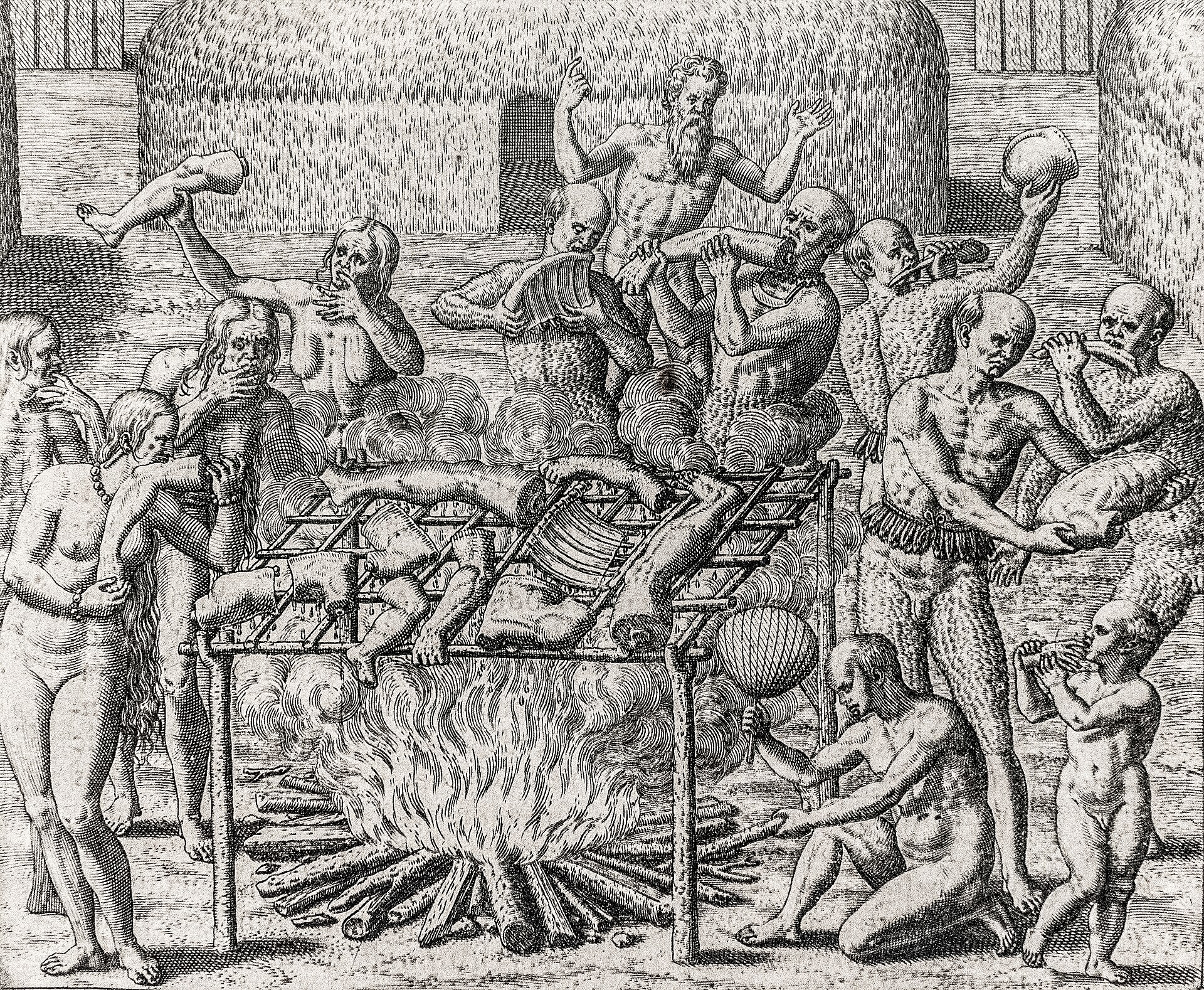
By depicting and labeling the Tupinambá as cannibals (Fig. 2), European colonizers constructed an absolute boundary between the ‘civilized’ self and a dehumanized other, one that conveniently justified the full apparatus of colonial violence. Anthropophagy thus functioned less as an ethnographic observation than as a political instrument.
Brazilian modernists, then again, turned this colonial process of othering inside-out. They reintegrated the cannibal as objectified Other into the self-definition of Brazilian subjectivity and actively deployed anthropophagy as an aesthetic tool of incorporation and as a political figure to critique colonial power relations. Anthropophagy in Brazil emerged as an aesthetic and political act of resistance. Notably, the Revista de Antropofagia (Journal of Anthropophagy) and the Movimento antropofágico (Anthropophagic Movement), founded in the 1920s by Oswald de Andrade, Tarsila do Amaral, Mário de Andrade, and others, redefined anthropophagy against colonial narratives through acts of reappropriation.
The cultural history of anthropophagy in Brazil is rich and contested, having been debated, revised, and reimagined in many ways since the 1920s. A detailed exploration is beyond the scope of this text; however, what matters for this analysis is that anthropophagy carries an opposed set of emotional, symbolic, and political meanings in Brazil compared to the Western tradition. As Rivas Gagliardi puts it, cannibalism in Brazil bridges technological progress with archaic ritual, thereby conveying ideas of emancipation rather than abjection:
There is a balance between the objective transformation (technological progress) and the subjective transformation (decolonization) of Brazilian society: the old, morally and scientifically negative assessment of indigenous rituals is now interpreted as an expression of emancipation. In this sense, antropofagia becomes a forerunner of postcolonial thought. (Rivas Gagliardi 2024, 229, transl. H.P.)
Western and Brazilian understandings of anthropophagy convey diverging affective and semantic layers. Yet in both directions, anthropophagy serves as a cultural marker for questioning the “structure of ideas” (Douglas 2002 [1966], 150) that individuals and societies construct for their self-definition. Cannibalism – both literally and metaphorically – cannot be separated from how bodily organization is shaped. Instead, anthropophagy brings into focus the margins of social organisms, revealing them to be more vulnerable than we often believe.
2. Cannibals Infiltrating the Cinema
The cannibal as a figure of ever-threatening yet always-desirable alterity reliably re-emerges across different times and cultural contexts whenever questions about social integrity surface at the most fundamental level. To trace these cultural histories of cannibalism cinematographically, I examine three films that translate the Western and Brazilian frameworks outlined above into filmic form – while also introducing a third, distinct context of culture-specific negotiation: Japan. Delicatessen (Jean-Pierre Jeunet and Marc Caro, FR 1991), a canonical example from France, interrogates the relationship between cannibalism and the unresolved tensions of post-fascist nationhood. Fires on the Plain (野火, Nobi, Ichikawa Kon, JPN 1959) situates anthropophagy within the devastating final phase of Japanese imperialism and its aftermath. Macunaíma (Joaquim Pedro de Andrade, BRA 1969) draws on the Brazilian anthropophagic tradition to stage a confrontation between cannibalism and authoritarian nationalist ideology. All three films lead us to ask: what role does cannibalism play in each of these cultural contexts and what does it reveal about the relationship between national self-images and what a society cannot bring itself to acknowledge?
2.1 French Cannibalism: Devouring Post-Fascist Nationhood
Delicatessen is a highly stylized, colorful chamber piece. Set in a dilapidated apartment building with leaking pipes and rooms filled with frogs and snails, its inhabitants reflect an authoritarian social structure; the building itself becomes a “hermetic living organism”, as Graeme Hayes argues (1999, 199). This microcosm revolves around the figure of the “mauvais père incestueux” (ibid., 203), the butcher, who supplies the inhabitants with meat – specifically, human flesh. Cannibalism here is not treated as an abnormal catastrophe but as the foundation of social order, as Hayes notes: “The force of Delicatessen is that the cannibalism is not seen as perverse, abject or irrational within the community, but with resignation, as an everyday fact of life of the new social order” (ibid., 204).

Despite its devastated world – devoid of kindness, empathy, and happiness – the film remains joyful, funny, and heartwarming. Through vivid color schemes, a dadaist set design, ironic subversions, numerous intertextual references, and an interwoven love story, Delicatessen transforms its depiction of cannibalism into a complex, multifaceted prism. Hayes describes this style as a “postmodernist aesthetic” of a “pastiche culture” (ibid., 198). While cultural critics such as Fredric Jameson diagnose postmodernism with a loss of critical distance and historical awareness (cf. Jameson 1984), Hayes sees postmodern pastiche as enabling a specifically critical perspective. His analysis of the postmodernist cannibalism in Delicatessen leads to confronting France’s “complicity in the Holocaust” (Hayes 1999, 204).
As Hayes points out, the figure of the authoritarian patriarch controlling a hierarchically organized social microcosm points to a fascist governance principle. Either the weakest member or someone who threatens the butcher is sacrificed. Everyone in the building is aware of the killings, but an atmosphere of resignation leads to acceptance of the cannibalistic supply chain. More explicitly, a specific iconography of the Vichy regime is evoked:
The newspaper, Les Temps difficiles, which recalls propaganda sheets such as Je suis partout or L’Affiche rouge; the use of the word complot on the stairwell poster; the Troglos, a (literally) underground resistance movement; the codes which recall the messages on Radio Londres sent to the maquis during the war; the newspaper used to blackout the windows in the pre-title sequence; and the fact that the two principal organisers of the system are simply known by their job titles, Boucher and Facteur, themselves not human but machine parts in the Administration. (ibid., 200)
The film thus stages the Vichy regime (in an analogy of the cannibalistic household) as a prototypically fascist system. Cannibalism here functions to reveal a fascist self-organization within France that has long been subsumed under the fascism of the German occupation, rather than addressed as a crime in its own right. For Hayes, the fact that Delicatessen overtly deals with the fascist logic of the Vichy regime and consequently foregrounds French complicity in the Holocaust is not coincidental. The film’s release in 1991 coincides with a significant, albeit belated, reevaluation of the Vichy regime’s responsibility for fascism across the political and cultural realm:
In 1995, […] Jacques Chirac became the first French head of state to acknowledge the nation’s responsibility for such acts, breaking with the thesis supported by the four previous presidents of the Fifth Republic that France was not responsible because the Vichy state was not legitimate. (ibid.)
Amid this atmosphere of national identity crisis in the 1990s, the cinematographic cannibalism in Delicatessen can be seen as both a symptom of and a medium for revealing the unspeakable. The guilt of French antisemitism, externalized for decades after the war, begins to haunt the post-fascist self-image the nation so carefully constructed. The social order built on that self-image is consumed in an act of cinematic cannibalization.
2.2 Japanese Cannibalism: Devouring Post-Imperialist Nationhood
In a markedly different aesthetic register but with a comparable political gesture, Fires on the Plain explores the suppressed aspects of post-imperialist nation-building in Japan. An explicit anti-war film set during the final phase of World War II on the Philippine island of Leyte, it follows Private Tamura, a soldier suffering from tuberculosis who is abandoned by his regiment and left to wander a landscape of dying soldiers. Cannibalism becomes the last means of survival. Yet while other Japanese soldiers kill and eat their enemies or comrades, Tamura resists the urge despite his overwhelming hunger.
In his 2020 essay, Kenta McGrath analyzes Fires on the Plain alongside its eponymous 2014 remake by Tsukamoto Shinya (Nobi, JPN 2014), Fukasaku Kinji’s Under the Flag of the Rising Sun (軍旗はためく下に, Gunki Hatameku Moto ni, JPN 1972), and the documentary The Emperor’s Naked Army Marches On (ゆきゆきて、神軍, Yuki Yukite Shingun, Hara Kazuo, JPN 1987). McGrath argues that all four films critically examine the dehumanizing effects of the imperial military system through the depiction of cannibalism and thereby challenge the official image of Japanese militarism based on honor, order, and sacrifice: “Of the 1.74 million Japanese military deaths in the Pacific War, it is estimated that two-thirds were due to illness and starvation rather than combat” (ibid., 73). In this context, cinematographic cannibalism highlights an aspect of Japanese imperialism often overlooked: the imperial system’s fatal indifference toward its own soldiers.
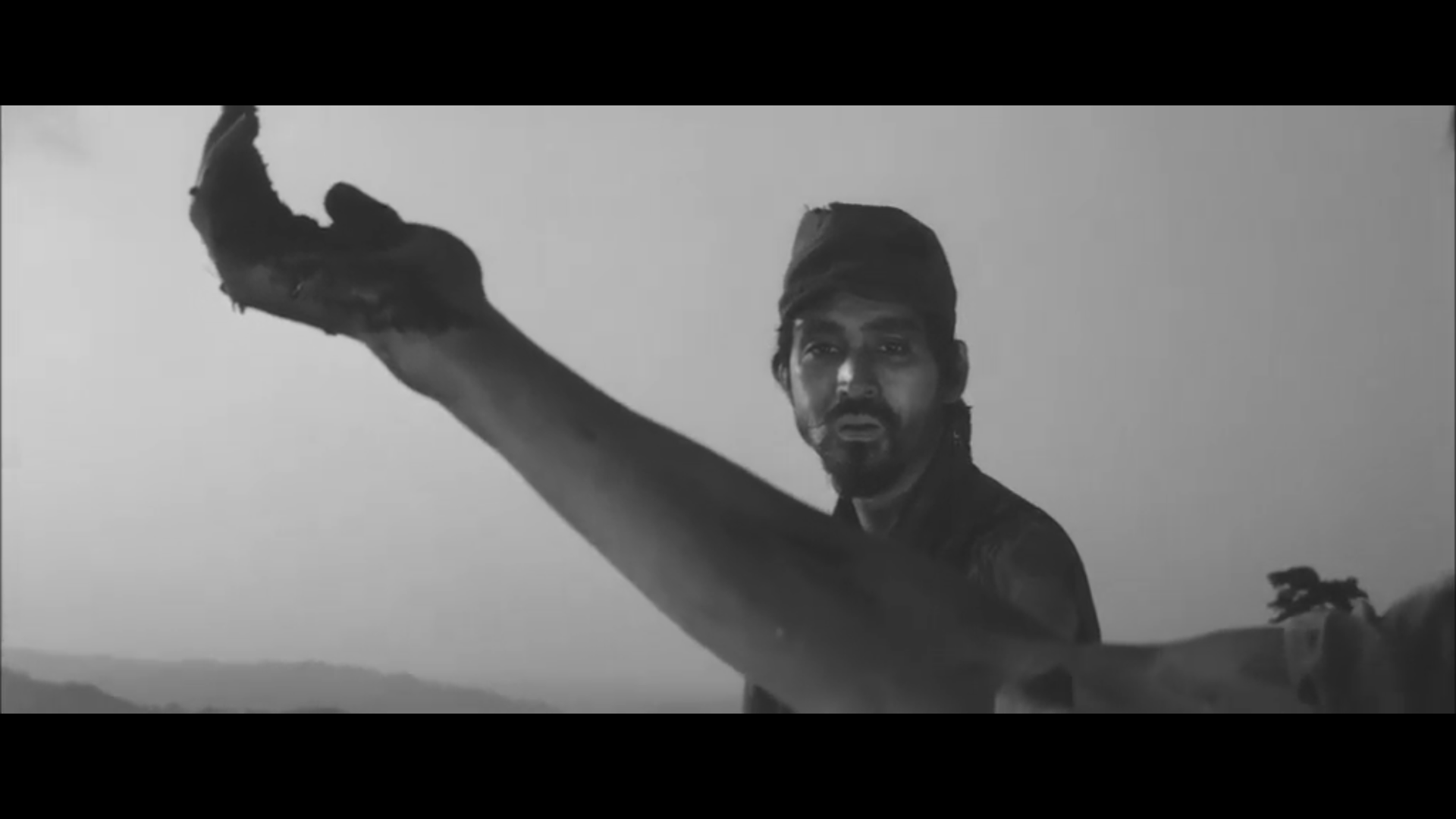

Fires on the Plain is the most powerful of the four films, both politically and aesthetically. Through carefully composed images, superimpositions, and body fragmentations, it conveys the horrors of war and cannibalism without relying on shock tactics or visually explicit violence (as the 2014 remake does). The mise-en-scène between foreground and background directs attention toward cannibalistic desire without stating it explicitly (Figs. 4–5). As McGrath also notes, the film goes beyond depicting war cannibalism as mere survival tactic: it reveals “cannibalism and militarism as deeply intertwined” (ibid., 85) – not as a gruesome side effect of war but as a necessary outcome of the militarist ideology rooted in Japanese imperialism. After the war, a “victimhood consciousness mentality (higaisha ishiki)” took hold, leading Japanese citizens to see themselves primarily as victims of the U.S. atomic bombings rather than aggressors (ibid., 72). Although Fires on the Plain does not fully break from this framework – focusing on Japanese soldiers and largely ignoring Philippine victimhood – McGrath argues that it complicates the question of where victimhood ends and aggression begins.
With Delicatessen as a vibrant, dadaist chamber piece and Fires on the Plain as a politically charged anti-war film, we see cinema deploying different aesthetic approaches toward the same end: cinematographic cannibalism emerges when societies question national self-images rooted in ideals of purity, one-sided victimhood, and guilt-free patriotism. In both cases, it reintroduces the rejected parts of national trauma into the self-perception of nationhood and forces the supposedly healed social body in post-war culture to confront its margins.
2.3 Brazilian Cannibalism: Devouring Post-Colonial Nationhood
With these two post-war negotiations of cannibalism in mind, I now return to the Brazilian context to examine more closely the significance of cinematic cannibalism in the postcolonial tradition. As noted above, anthropophagy has a long and significant history in Brazilian culture. In cinema, this tradition resurfaces strongly in the 1960s and 1970s, from modernist Cinema Novo and Tropicalismo to the experimental Cinema Marginal and, arguably, the erotic films of the Pornochanchada genre. Peter W. Schulze (2015) describes this tendency as Neo-Antropofagismo and, focusing on anthropophagy in Tropicalismo, examines O dragão da maldade contra o santo guerreiro (Glauber Rocha, BRA 1969), Macunaíma (Joaquim Pedro de Andrade, BRA 1969), and Como era gostoso o meu francês (Nelson Pereira dos Santos, BRA 1972).
Emerging in the late 1960s amid military dictatorship and censorship, Tropicalismo represents a shift from the anti-colonialist art of the early 1960s toward a postcolonial aesthetic. Rather than outright rejecting Western or colonial influences, Tropicalismo advocated a selective “digestion” (Schulze 2015, 117) and transformation of Western culture, fostering a hybrid Brazilian identity. Anthropophagy was reinterpreted as a strategy of appropriation that complicated the official image of brasilianidade promoted by the military dictatorship. To clarify this line of anthropophagic critique, I want to look more closely at Macunaíma.
Adapted from Mário de Andrade’s 1928 modernist novel, the film depicts the life of Macunaíma, a ‘hero without any character’ who undergoes multiple transformations across Brazil’s landscapes. Macunaíma is born as a Black man (played by Grande Otelo) in the forest who eventually transforms into a white man after jumping into a magical spring. He travels to the city with his brothers, becomes involved with a female guerrilla named Ci, and enters a conflict with a cannibalistic industrialist giant, Pietro Pietra, to recover a magical amulet. After defeating the giant, Macunaíma returns to the jungle burdened with useless modern gadgets, falls into extreme laziness, and is ultimately devoured by the water spirit Uiara, leaving only a pool of blood behind.
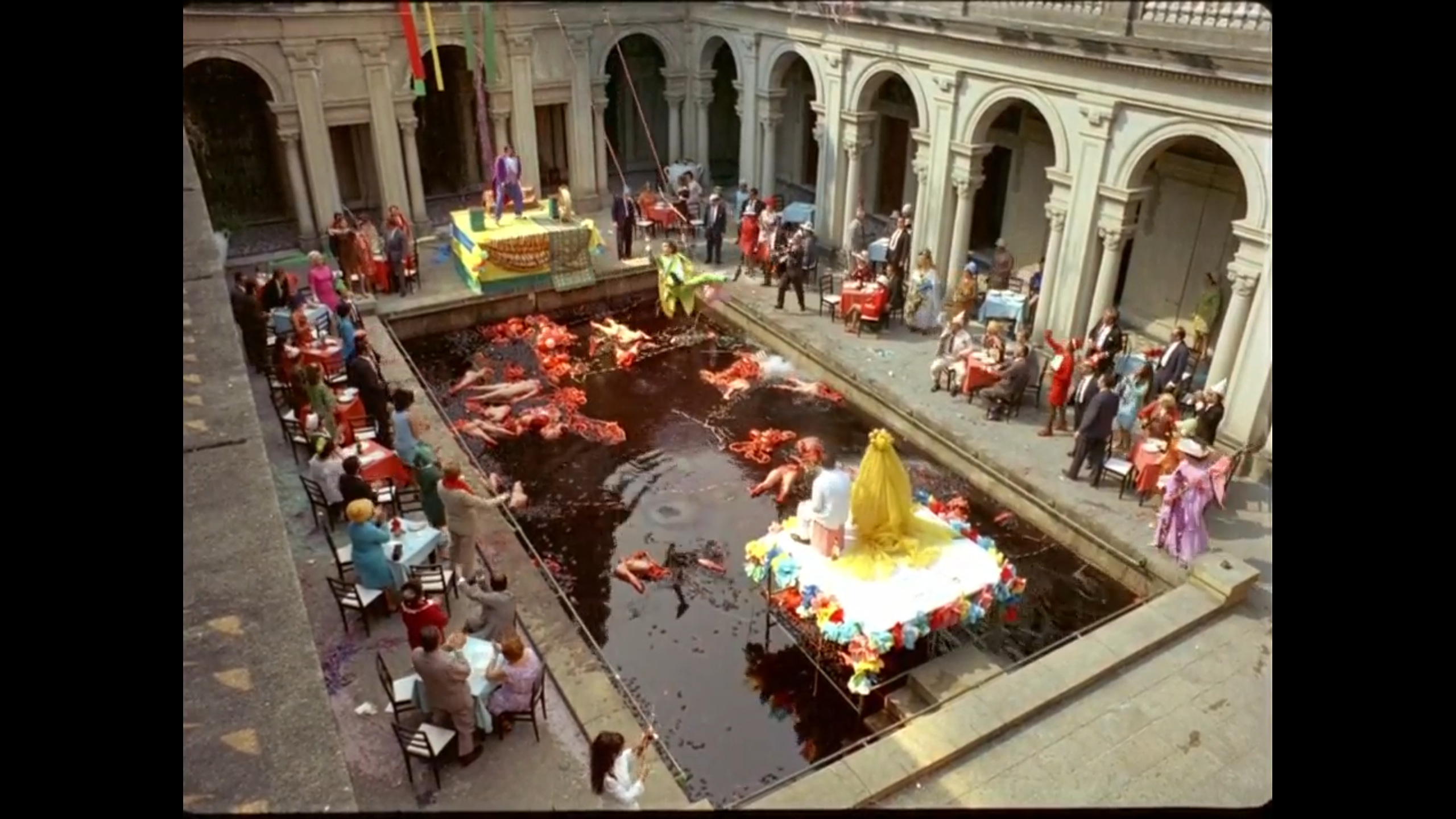
In the film’s key scene – the fight between Macunaíma and Pietro Pietra – the anthropophagic gesture of Tropicalismo reaches its peak. The scene depicts a wedding celebration: Pietro Pietra’s daughter is getting married, and he organizes a great feijoada feast (a traditional Brazilian stew). The feijoada is made of human corpses floating in a pool (Fig. 6). As Peter Schulze observes, “the event comes across as a grotesque reflection of Brazilian society under the military dictatorship” (ibid., 180, transl. H.P.). Symbols of Brazilianness are omnipresent: the scene is saturated with the colors of the Brazilian flag, the Parque Lage villa (where it is set) is a well-known site in Brazilian film history, and the wedding party plays the jogo do bicho, a famous Brazilian lottery game. As Schulze explains:
The wedding celebration is a parody of the patriotic posturing of the military government and its supporters, particularly the state propaganda with its constant celebration of Brazilian national symbols. The military regime’s exaggerated patriotism is taken to the extreme, especially when several Brazilians perish in their own national dish and, amid general enthusiasm, become part of the other guests’ feast. (ibid., 182, transl. H.P.)
Hence, under conditions of repression, persecution, and insecurity, anthropophagy re-emerges in Brazil to challenge, mock, and oppose the military government’s official portrayal of nationhood. Although set in a different era and cultural context than the previously discussed films, cannibalism here once again brings the marginalized, rejected aspects of the national ‘I’ back into focus.
3. From Cinematographic Anthropophagy to AI Data Cannibalism
Time and again, anthropophagic cinema emerges at moments when purified and glorified images of (national) subjectivity begin to crumble. Anthropophagy represents the abject of social formation that haunts the self-idealizations of identity. Just as the body of the eaten returns into the living body through the cannibalistic act, anthropophagy as a cultural symbol re-emerges within the living social organism whenever the very structure of ideas about that organism is called into question. Anthropophagy consumes the national images of innocence in post-war France, of victimhood and the logic of honor in post-war Japan, and of Brazil as an open, tolerant, and progressive nation that has moved beyond colonialism during the military dictatorship.
Drawing on this analysis of anthropophagy as a culturally variable marker for questioning purified identity formations, let us return to the initial question of AI data cannibalism. What does designating AI systems as cannibalistic convey? First, we must recognize that calling something ‘cannibalistic’ is well-suited to the digital attention economy. Labeling the training of AI systems with synthetic data as ‘cannibalistic’ functions as clickbait and immediately frames the process as harmful or dangerous. Yet if we look past its obvious initial layers, the metaphor opens onto something more consequential: it reveals the organismic imaginary that structures current thinking about AI.
On closer reflection, describing AI data processing and training as ‘cannibalism’ is quite counterintuitive. It implies that both AI and the data it produces are living entities capable of digestion, metabolism, and excretion. In the narrative of AI consuming its own offspring (Kerner 2025), it also attributes a reproductive quality to AI, usually reserved for living beings. Hence, although ‘cannibalism’ carries connotations of violence and death, it also conveys a vitalistic idea of AI: you must be alive to eat, and you must be alive to be killed for consumption. This vitalistic undercurrent is not incidental; paradoxically, even though aimed at criticizing current developments in AI, the notion of cannibalism closely aligns with a strand of tech philosophy that has gained considerable traction in Silicon Valley. One of its most explicit proponents is Blaise Agüera y Arcas, AI researcher and Fellow at Google. In his 2024 text, “What Is Intelligence? Lessons from AI About Evolution, Computing, and Minds,” published both as book by MIT Press and in the Journal for the Philosophy of Planetary Computation, Agüera y Arcas argues that life is fundamentally computational, placing biological origins such as abiogenesis and symbiogenesis alongside the development of synthetic systems (Agüera y Arcas 2024). His stance on what intelligence designates draws heavily on analogies between biological and mechanical organisms – and the central vehicle for this analogy is the act of eating.
For Agüera y Arcas, the pivotal moment in the history of Artificial Intelligence is not the invention of the digital computer but the steam engine. The Watt engine of 1776 was, he argues, the first machine to manage thermodynamic stability the way a living organism does during metabolism: “for the first time, human-made machines began to metabolize on a large scale, ‘eating’ complex organic molecules to perform mechanical work” (ibid., chapter “Thermodynamics”). By casting the steam engine as the inaugural metabolizing machine, Agüera y Arcas references ideas from 1940s and 1950s cybernetics and inscribes a continuous line from early industrialization to contemporary AI. Each step represents a further development of the same fundamental process: the expansion of metabolism beyond biological bodies. Food consumption and, consequently, metabolism are understood as thermodynamic processes aimed at stabilizing a system. He acknowledges that “hardware and software are, in general, unable to reproduce, grow, heal, or evolve on their own, because engineers learned long ago that self-modifying code (like bff, or DNA) is hard to understand and debug” (ibid., chapter “Élan Vital”). Yet he twists the argument by bridging human organisms and technological devices in a “larger, symbiotic ‘us’” (ibid.). Understood in this sense, the anthropotechnical ‘us’
is certainly reproducing, growing, and evolving. The emergence of technology, and the mutually beneficial – if sometimes fraught – relationship between people and tech is nothing more or less than our own most recent major evolutionary transition. Technology, then, is not distinct from nature or biology, but merely its most recent evolutionary development. (ibid.)
This line of argumentation is not merely an actualization of cybernetic thinking but a radicalization which, in fact, re-weights it and pushes it toward a far stronger stance. In his AI theory, Agüera y Arcas explicitly refers to cybernetic thought to strengthen his argument for not only an analogization but basically an equation of technological and organic organization principles. Cyberneticians such as Wiener, Rosenblueth, Bigelow and Ashby proposed that principles of self-organization, self-repair, and purposive behavior (which until then were exclusively attributed to living beings) could be accounted for in mechanistic terms. The organism is understood as a machine of a particular kind, one that processes information and regulates itself through feedback loops. As Matteo Pasquinelli describes in his AI study The Eye of the Master, “cybernetics claimed to have found in all organisms a basic ‘mechanism’ of behavior” (Pasquinelli 2023, 139). Their principal move tended towards explaining life through a mechanical lens.
The resurfacing of cybernetic thought in Agüera y Arcas leads into an altered direction and, above all, an altered emphasis: instead of rationalizing life, his view on AI actively rehabilitates vitalist metaphysics by drawing on Henri Bergson and contemporary scholars like Jane Bennett (Agüera y Arcas 2024, chapter “Élan Vital”). Agüera y Arcas pushes the cybernetic equation in the direction of vitalism rather than mechanism: if organisms work like machines, then machines are nothing more than natural consequences of an evolutionary biological process. Through the vitalization of technical organization principles, AI emerges as quasi-inevitable, autonomous stage of biological evolution rather than a mechanistic model borrowed from it. While cybernetics sought to weaken the contrast between vitalistic and mechanistic reasoning, Agüera y Arcas – exemplary for a predominant line of thought in current Silicon Valley discourse – seeks to restore vitalism at the heart of machines. Even though aiming at a similar conversion, the two gestures thus differ in direction and ideological charge: whereas early cybernetics tended to demystify the organism, Agüera y Arcas re-mystifies the machine.
Despite these differences, for both projects – the cybernetic mechanization of organisms and Agüera y Arcas’ vitalization of the machine – the eating metaphor is central. It serves as a bridge between the organism and technological principles. Consequently, in the designation of the training of AI systems with synthetic data as ‘AI data cannibalism’ the presumed criticism of the process becomes conceptually self-defeating. As a critique, the term is meant to signal the pathological closure of the AI training loops, a system consuming its own outputs, degrading toward collapse. Yet the very grammar of the accusation (a system that eats, digests, reproduces) presupposes an organismic model of AI. The critic who invokes ‘AI cannibalism’ to warn against synthetic data training thereby concedes, at the level of the metaphor itself, the rhetorical scaffold of a naturalization that normalizes these systems.
This structure is precisely that of the abject as described by Kristeva: that which is expelled in order to constitute the subject returns in the very act of expulsion. ‘Data cannibalism’ attempts to cast AI as dangerous because it deviates from a norm of epistemological knowledge production but in doing so, it confirms that AI can be perceived as evolutionary norm on a deeper level. AI, as the rejected part of current human identity struggle, reenters as the ever haunting abject through the back door into the core concepts of our self-definition as organically constituted beings. The core issue at stake here is the fundamental difference between biological and mechanical organisms: by erasing this distinction (whether from the direction of cybernetic rationalism or of Silicon Valley vitalism) AI researchers reinterpret the traditional notion of linear technological progress as biological and therefore as an inevitable form of evolution. The traditional notion of teleological progress is being repackaged as techno-biological determinism. The discourse of AI data cannibalism unconsciously adopts this line of thought, since the idea that machines can eat and metabolize extends the analogy from brains and neural networks to machines, framing them as functioning like living entities in a broader sense.
This line of reasoning currently poses one of the most unsettling threats to the ‘structure of ideas’ (in Douglas’s terms) of human self-imagination. Cannibalism thus plays a twofold role. On the one hand, it subconsciously stabilizes the equation of biological and technological ‘life’ – an equation that Pasquinelli shows has been operative, in structurally different but functionally comparable forms, at least since the 1940s. The unsettling notion that humanity is not the pinnacle of creation but merely one step in a continuous process of techno-biological evolution is now becoming widespread – interestingly, both in Silicon Valley discussions and in critical post- and trans-humanism, new materialism, and techno-philosophy (typically politically wary of Silicon Valley ideology) that Agüera y Arcas takes his vitalist argumentation from. That these positions converge on a shared organismic imaginary, despite their opposing philosophical routes to it, is itself a symptom of how thoroughly the boundary collapse between organism and machine has permeated contemporary thought.
On the other hand, invoking cannibalism at this crucial moment of crumbling human self-definition signals the fundamental insecurity of humanity’s status. Anthropophagy appeared in the cinematographic universes described above when societies questioned the forms they had given themselves. In 1990s France, anthropophagic imagery surfaced questions of complicity in the Holocaust. From the 1950s onward, it catalyzed discussions about war crimes and guilt in Japan. In the 1960s and 1970s, anthropophagy challenged neo-colonial capitalist greed and violence in Brazil’s military dictatorship. Similarly, cannibalism surfaces in current AI debates as a symptom of deep uncertainty about such categories as ‘human’, ‘machine’, ‘intelligence’, and ‘evolution’. What distinguishes the cinematographies previously described from the current discussion of AI is that the structure of ideas now put into question through cannibalism is no longer the structure of national self-identification but the structure of human identity as a whole. Cannibalism brings to the fore suppressed questions about the status of the human when technology dismantles previously stable boundaries. It raises the question on a global scale: what structure of ideas can adequately represent ‘the human species’ when (AI) technology threatens the very margins of that structure – and when the discourses meant to warn against that threat are themselves complicit in naturalizing it?
To look ahead, we may turn our attention once again to the Brazilian discourse on anthropophagy. Rather than remaining within the Kristevan register of the abject, in which AI cannibalism operates, some voices from Brazil have been emerging that draw on the notion of “inteligência artificial antropófaga” (anthropophagic artificial intelligence; Vianna 2017, Cantarini 2022) to counter currently dominant discourses on AI. Until now these voices have remained marginal, utopian, provocative, or poetic interventions. They call for algorithms that are not based on yes/no decisions but rather on “believing in both yes and no at the same time”, and that position multiplicity as an overarching goal rather than singularity (Vianna 2017, transl. H.P.). The idea of using anthropophagy as an operative principle – to devour and digest the Silicon Valley discourse on AI and turn it inside out, instead of simply rejecting its basic functioning – nonetheless seems like an alternative worth considering. Still speaking the alimentary language of eating and incorporation, this critical gesture runs the risk of reproducing the premises of current AI determinism once more. But where the abject model smuggles those premises in, unwittingly, the anthropophagic gesture seizes the metaphor knowingly and bends it to other ends. This reappropriation remains a task for a genuinely postcolonial critique of artificial intelligence that goes beyond equations of organism and machine – a critique that might actually be able to take into account political and social power dynamics, instead of updating cybernetic ideas by cloaking them in a new, evolutionary techno-biological determinism.
Notes
- 1This article grew out of conversations with Mace Ojala at Ruhr-University Bochum. I am grateful for the stimulating exchange, particularly on the role of cannibalism as a metaphor in current AI debates.
Bibliography
- –Agüera y Arcas, Blaise (2024): “What Is Intelligence? Lessons from AI About Evolution, Computing, and Minds.” MIT Press / Journal for the Philosophy of Planetary Computation. https://doi.org/10.1162/ANTI.5CZB. Last accessed: 12 June 2026.
- –Andrade, Oswald de (1928): “Anthropophagic Manifesto.” In: Marques, Pedro N. (ed.): The Forest & The School: Where to Sit at the Dinner Table? Transcribed by V. S. Conttren, June 2020, pp. 99–110.
- –Cantarini, Paola (2022): “Por uma inteligência artificial antropófaga.” Migalhas (Humanidades e Novas Tecnologias). https://www.migalhas.com.br/coluna/humanidades-e-novas-tecnologias/373092/por-uma-inteligencia-artificial-antropofaga. Last accessed: 14 June 2026.
- –-Douglas, Mary (1972): “Deciphering the Meal.” Daedalus 101/1, pp. 61–83.
- –Douglas, Mary (2002 [1966]): Purity and Danger: An Analysis of Concepts of Pollution and Taboo. London: Routledge.
- –Rivas Gagliardi, Laura (2024): “Antropofagia, ein Grundbegriff der brasilianischen Kulturgeschichte.” In: Béreiziat-Lang, Stephanie (ed.): Kannibalismus und Eucharistie: Frühneuzeitliche Figurationen des Einverleibens in den romanischen Literaturen. Berlin/Boston: De Gruyter, pp. 221–245.
- –Hayes, Graeme (1999): “Replaying History as Farce: Postmodernism and the Construction of Vichy in Delicatessen.” Modern & Contemporary France 7/2, pp. 197–207.
- –Jameson, Fredric (1984): “Postmodernism, or the Cultural Logic of Late Capitalism.” New Left Review 146, pp. 53–92.
- –Kerner, Sean Michael (2025): “AI Cannibalism Explained: A Model Failure.” TechTarget. https://www.techtarget.com/whatis/feature/AI-cannibalism-explained. Last accessed: 20 March 2026.
- –Kristeva, Julia (1982): Powers of Horror: An Essay on Abjection. New York: Columbia University Press.
- –McGrath, Kenta (2020): “White Pigs and Black Pigs, Wild Boar and Monkey Meat: Cannibalism and War Victimhood in Japanese Cinema.” In: Rivera, Serena J.; Kiviat, Niki (eds.): (In)digestion in Literature and Film: A Transcultural Approach. London: Routledge, pp. 71–88.
- –Pasquinelli, Matteo (2023): The Eye of the Master: A Social History of Artificial Intelligence. London: Verso Books.
- –Schulze, Peter W. (2015): Strategien ‚kultureller Kannibalisierung‘: Postkoloniale Repräsentationen vom brasilianischen Modernismo zum Cinema Novo. Bielefeld: transcript.
- –Vianna, Hermano (2017): “Inteligência artificial antropófaga.” https://hermanovianna.wordpress.com/2017/10/21/inteligencia-artificial-antropofaga/. Last accessed: 14 June 2026.
- –Wehrheim, Monika (1999): “Der Kannibale – die Kannibalin: Zum Zusammenspiel von kolonialem und misogynem Diskurs.” In: Hanau, Volker et al. (eds.): Geschlechterdifferenzen: Beiträge zum 14. Nachwuchskolloquium der Romanistik, pp. 23–32.