
43 — July 2026
FRICTION/LESSNESS (1/2)
Margaux Schwarz & Arne De Winde (eds.)
This double cluster focuses on the (media) culture and aesthetics of what we provisionally term “frictionlessness”. The issues explore how contemporary digital media environments cultivate an intolerance of friction—understood as resistance, ambiguity, delay, discomfort, or frustration—and how this shift profoundly reshapes relational dynamics and modes of spectatorship.1
Digital platforms increasingly privilege smoothness, immediacy, legibility, and affective manageability. These values not only structure how cultural and artistic works are produced, circulated, and framed, but also inform institutional practices, curatorial decisions, pedagogical models, and discourses of care. The avoidance of friction, or its pre-emptive neutralization, is thus no longer merely a technical or aesthetic concern, but a broader cultural logic with ethical, political-ideological and epistemological implications.
In the following double issue, we seek to test the hypothesis that strategies developed within digital visual culture—such as algorithmic optimization, confessional address, literalism, affective transparency, and the management of discomfort—circulate virally and often unconsciously into the wider cultural field. Once adopted there, these strategies are frequently redefined and legitimized through normative frameworks of ‘accessibility’, ‘user-friendliness’, ‘practicality’, and ‘care’. While these frameworks are not rejected outright, the special issues seek to critically examine how they may also function to depoliticize friction, foreclose aesthetic ambiguity, or regulate spectatorship in subtle but pervasive ways.
Notes
- 1 Talking about discomfort and delay: while developing this cluster, we were unaware that the term frictionlessness had already been coined by Jakko Kemper. In Frictionlessness: The Silicon Valley Philosophy of Seamless Technology and the Aesthetic Value of Imperfection (2024), Kemper examines the “fetishization of frictionlessness” in digital consumer technologies and argues for the aesthetic value of imperfection as a productive source of friction. Our provisional use of the term thus emerged independently, before encountering Kemper’s work—a serendipitous reminder that friction sometimes arrives precisely through the delays and detours of research.
a
The Unbearable Jouissance of Social Domination
Caszimir Cleutjens

Introduction
One day back in the 90s, in a restaurant with my middle-class family, as a slightly sanctimonious child of about eight years old, I was struck by a moral urge to help out the waiters with collecting the dishes and glasses from our table and others’. I was for some reason suddenly uncomfortable with us sitting there, having desserts and digestifs and speaking freely, and with the idea that, just because we were going to leave money there, we expected these people to ‘lower themselves’ to handle our foodscraps and leavings for us when we could perfectly well help out. If everybody chipped in, these anonymous figures could maybe be freed up to have a good time themselves, and do whatever they felt like doing.
My parents explained to me that I’d probably only be interfering with the waiters’ work. Furthermore, it could even be insulting if I took away their tasks from them, which would leave them standing there rather useless, being paid to do nothing. It would precisely signal that their tasks were not a serious job, if literally a child could do it. And my feeling sorry for them was perhaps more condescending than having them work for us. There had been a tone-deafness in my sanctimony and sense of justice.
In my tablewaiting and bartending jobs throughout my twenties, that advice was confirmed in many ways. Not just children but adult customers, in a sudden urge to be friendly or congenial, would take it upon themselves to leave their dishes not on their table, where we would have swooped them up in an instant of muscle-memory, but anywhere else, I guess closer to wherever they thought the kitchen was: on surfaces logistically dedicated to clean drinks or new plates of food, for example, effectively blocking and dirtying our workflows; or in places where they would not be found until closing time; and generally making our lives harder if anything indeed. Sometimes, they would get up with their dishes in hand and then stand around lost and expectant in the pathways, stopping you in your tracks to hand you their dishes physically, ultimately bothering you more than necessary while also expecting to be congratulated in their unassuming autonomy.
As a waiter serving you, I need you to stay within your role and allow yourself to be served, just as much as you expect me to play mine. In fact, the more virtuosic and adapted you are in this dramaturgy of ‘first-degree’ condescension, the easier and more dignified my job will be; whereas, the more you show discomfort with this dimension of power, the more a ‘second-degree’ condescension announces itself. To breach the expectations tends to accentuate, rather than mitigate, the shame and inequality that such a breach tries to address.
Like my eight-year old self, we should be careful not to immediately project this shame onto the service worker themselves, and the question must be kept in mind why reproductive work would imply ‘lowering oneself’. Perhaps this shame is first of all ours, as customers.

The choreography between waitstaff and customers places customers in a position of commanding, or even commandeering, reproductive labor through economic means. On the one hand, there is jouissance in this drama of social domination, and it is not impossible or uncommon for it to be exploited without shame. Performance artist Michael Staublein Jr., who used to work as a waiter in high-end restaurants, shared the following story with me:
I was very good at my job at this point. I actually felt more in control than the guests. They were in my hands, more than I was in theirs. One day, though, I walked up to a table and began to introduce myself and the day’s menu as I usually would, but before I could even get out a few words, one of the gentlemen interrupted and said, What we’ll do is, we’ll start by having you get us the following drinks, and then you can tell us all the things you wish to tell us. That made me feel the most inferior and subservient. It reminded me that at the end of the day, I’m a servant. I can avoid feeling like a servant by being a good server, but here, the curtain dropped for me.1
On the other hand, however, this jouissance constantly risks becoming shameful or unbearable – I think my eight-year old self was not wrong to feel this. It therefore needs to be dissimulated, softened, disclaimed and mitigated in myriad ways, all while being offered up as a difference potential.
As an illustration of this, think of how in higher-end establishments the service workers’ attire and composure are expected to mirror and equal the quality, dignity, and class of the patrons, signaling equality rather than submission or inferiority – but never too much of it, of course. In more middle-class cafés and bars, a service worker risks being dressed precisely too formally, and embarrassing or alienating the clientèle, if they show up in a white button shirt and slacks, as they would be expected to do in an uppity restaurant. Instead, they’re expected to dress like they would if they were hanging out with their friends, to ‘show themselves’ and emanate an horizontalist, pas trop de chi chi vibe. This horizontality seems to chase away the evil spirits of social domination, but while doing so, conjures them as possibility.
In the rest of this article, I will look at how digital and economic developments of the past three to four decades in the service industry play into this dissimulation of social domination, which simultaneously accentuates or dramatizes it. A growing anti-capitalist, anti-ecocidal, and anti-patriarchal awareness, in tandem with the hollowing out of the middle classes’ purchasing power, and the COVID pandemic, have together given rise to a ‘communism-of-capital’ aesthetics of post-class luxury, tending toward automated and contactless exchange. This aesthetics invisibilizes reproductive labor just like patriarchal capitalism does, but it does so precisely in the places where reproductive labor would traditionally be performatively accentuated. I will try to trace how this tension leads to new and contorted forms of dramatizing labor in public space.
Service in the digital age: my eyes are down here
Let’s start by looking at arguably one of the earliest digital innovations in service choreography: the PDA-like handheld devices (Mobile Point Of Sales terminals or mPOS) that would replace the server’s pad and pen in many places, in my personal recollection around the late 2000’s and early 2010’s. Their principal logistical effect was to eliminate the server’s physical carrying of order info from the clients and tables back to the kitchen and bar, which now happens wirelessly and immediately. As we can see in The Bear (2022), waitstaff could now continuously keep taking orders, and tickets would simply begin appearing in the dark workshops where food and drinks are made, eliminating the delay of the server’s physical movement, and also – seemingly – eliminating human translation and memory errors. As a typical case of Taylorization, this radically severs ties between the servers and the ‘backstage’ producers of the actual goods, disconnecting their respective experiences of time and work pressure. On an affective level, this tends to pit the ‘production of orders’ against the production of ‘actual goods’ by cooks and other non-public-facing workers. 2
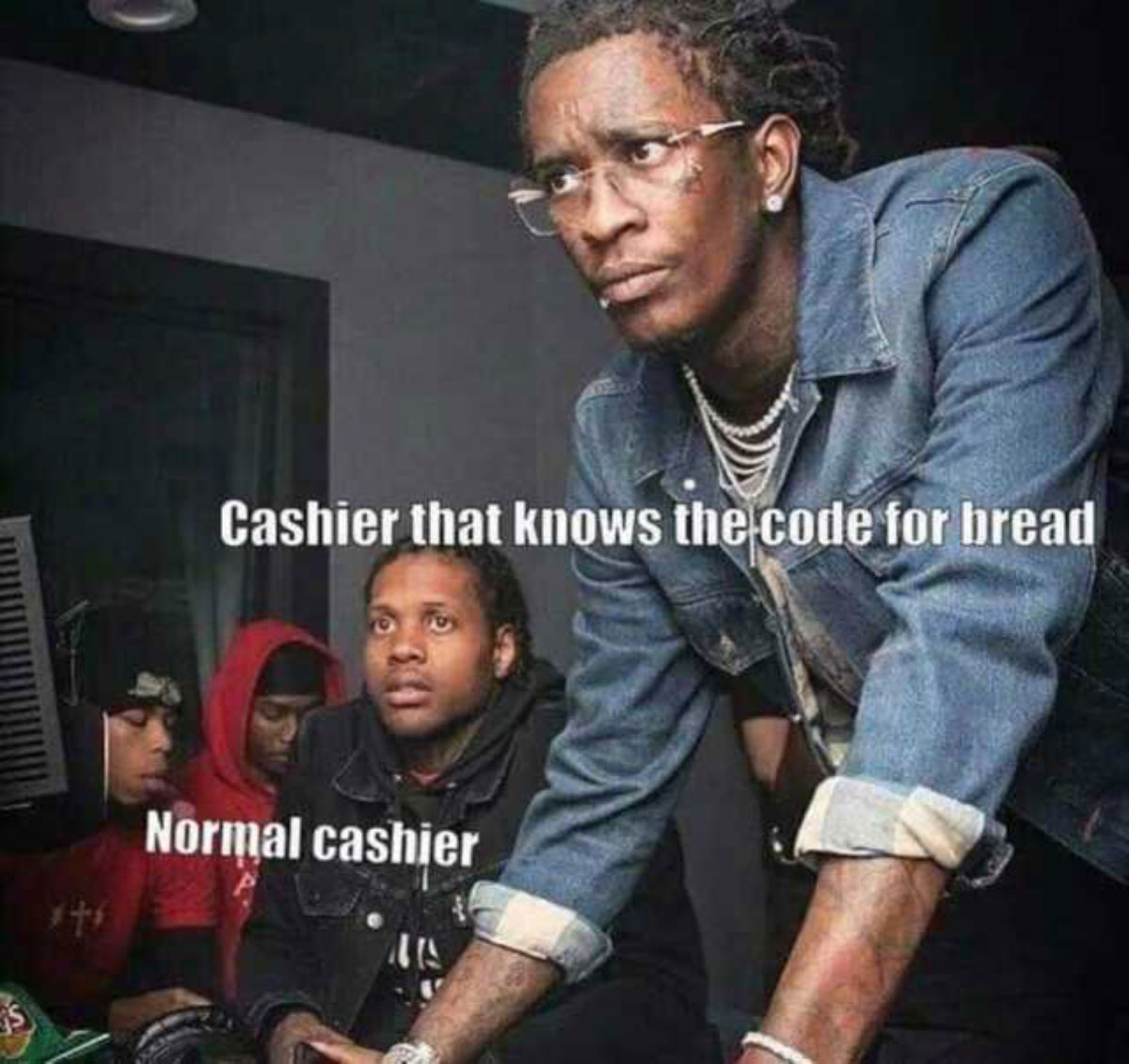
Whereas jotting down your personally developed shorthand on a pad allows you to maintain eye-contact with clients, by flitting back and forth from the pad, and to remain conscious, intentional and connected in your facial expressions, handling an infosystem makes this exercise considerably more challenging. While accelerating and optimizing the flow of information, even if it soon becomes second nature, the actual interaction and dramaturgy between server and customer is now paradoxically filled with the solemnity, expertise and anguish of ‘committing something to memory’ (a solemnity dramatized in the focused concern on rapper Young Thug’s face in the meme above). In the economy of attention between customer and server, this means that the customer loses a part of that undivided, docile attention from the server that the interrupting ‘gentleman’ in Michael Staublein Jr.’s anecdote above lays claim to. They can no longer even properly lay claim to the server’s gaze, which is glazed over by the mPOS screen as soon as you start ordering, frowning solemnly.
Another service worker shared with me how, with a new menu and new buttons to press, they found themselves asking each customer whether they wanted the ‘normal’ version of a certain dish, or a ‘special’ option that nobody ever picks, simply because they had to choose either one on the screen and it’s a decision, in the end, that you can’t just make for the customer. The dramaturgical center has shifted, away from the customer themselves, and even beyond the server, towards the device and the incorporeal consciousness it incarnates, who is now asking the questions.
Next, let’s look at contactless payment, which was already in vogue before the COVID pandemic. The pandemic, however, helped elevate contactless transaction to an aspirational norm for urban development policy. For the middling classes it has quickly become uncommon to carry bills or change while navigating urban space. This also affects our relationship to people asking for money in the street, sanitizing our refusal as somehow helpless, and pushing them behind a glass wall as if they literally hailed from a different historical era – although I’ve heard of people asking for money with an mPOS.
Imagine handing a server the cash you just counted, taking the change (and inspecting it or not), and perhaps leaving a tip (you have to tell the server personally, with your own voice and assertiveness, how much to subtract, or they have to wait for and witness you count it out). From there to swiping your card, to simply tapping your card or phone, obviously a lot of eyecontact, verbal exchange, and micro-occasions for posturing (as generous, as distrustful, as calm and collected, as funny) are lost. Both of you are verifying the exchange from behind your respective screens and simply commenting on what you see there. All emotion with regard to amounts of money – inspecting the bill studiously had already been taboo, of course – now simply has no occasion to exist, since nobody is physically counting money anymore. Lacking that margin of error where you could mistake a 20€ bill for a 50€ bill, there is no micro-moment of trust establishment. Next, the tip percentage suggestion options feel ‘corporate’, like clicking away cookie notifications or supermarket charity scams. It feels more natural and satisfying to leave some cash on the table. A digital tip doesn’t feel like it will make it to the server themselves, but to ask about this explicitly brings so much attention to your generous intentions that it becomes patronizing. Sometimes, you have to seize the moment before the server taps in the amount to ask them to add a tip to it, but jumping the gun like this feels tactless, compared to making an in-the-moment gesture with the change you just received. To accommodate your desire to tip, when they’ve already tapped in the amount to pay, the server has to cancel and start over the process on the mPOS, all the while saying ‘thank you’ or something of the kind.
These are perhaps subjective and banal observations, akin to ohdearism about ‘everybody being on their phones nowadays’, but I think they point to the progressive sanitation, through digitalization, of something dirty about the moment of transaction, and something unbearable about the service exchange as such.
The Gen Z stare: class consciousness?

This lament at the progressive elimination of ‘cosy’ social micro-exchanges of affect materialized as well, after COVID, in boomer horror at the ‘Gen Z stare’. During the reopening of businesses like Starbucks after the first lockdowns – and layoffs – apparently the post-COVID vintage of Gen Z baristas (lots of new, younger, cheaper hires) noticeably lacked the ‘baseline’ positivity and friendliness conventionally expected from such exchanges. They were suddenly doing none of what I would call the ‘face-work’, the reassuring performativity, tonal mimicry and adaptation that precisely works when it goes unseen. The ‘Gen Z stare’ is perhaps a permutation of the ‘resting bitch face’, the feminist refusal to ‘be agreeable’ and do the reassuring face-work that men aren’t expected to return in kind. The Gen Z stare became a meme as customers turned to TikTok, joining teachers in decrying the alarming lack of ‘basic social skills’ of the permanently online generation, who had spent a significant part of their teens behind screens instead of physically in contact in school. Commentators oscillated between compassion, alarm and indignation, speculating that the blank stare signalled a tragically impotent stimulus overwhelm or chronic social anxiety in younger generations; a social media-induced disadaptation to IRL communication; or, on the contrary, a conscious dissent and refusal of ‘positive performativity’;4 or, lastly, a fear that being friendly and positive could be perceived by others as ‘cringe’.
The accused, meanwhile, entering a TikTok deathdance with their detractors, generally insisted that the stare was simply justified by customers’ rude, childish and entitled behavior – their lack of basic social skills: “[you say I gave you] ‘The Gen Z stare’ but I asked you how your day was and you blurted your order at me”. What seems lacking in this justification is not social attunement per se (she seems quite ‘right’ to respond with bewilderment) but rather the ‘common’ sense that this kind of work might be about remaining friendly and reassuring precisely when your counterparty isn’t: the sense in which the ‘customer is king’, that any moral mistake or unbalance (blurting out the order in the middle of the service worker’s speech) is always ‘on the house’ – that as a service worker, you’re not supposed to be attuned as a real individual, but as an incarnation of ‘the house’.

While I can’t speculate on where this refusal comes from, or on how or why it manages to elude the discipline of service employment, I believe the furious boomer discombobulation that flooded TikTok signals a shame at that commonsensical social domination, which isn’t supposed to be addressed or pointed out. As the emoji formula for the stare shows, there is more than a Bartlebyan retreating gesture here: mouth slightly agape but uttering nothing, eye-contact relentlessly maintained but conveying nothing, and expecting the customer themselves to redirect and rectify the situation – which had precisely been the main task, and to all appearances the only task, of the service worker. The refusal to make the micro-exchange ‘cosy’ at all costs (what would it cost you to smile?) makes it suddenly and intentionally a very ‘uncosy’ matter that anyone felt entitled to a cosy exchange. Just because you are paying for the coffee, are you also paying for the exchange to be pleasurable? Perhaps there is a class consciousness here: what do such expectations cost in reality? Are we being paid enough for it?
The Gen Z stare breaks through the chiasm between intellectual and manual labor, and skilled and unskilled work, which unconsciously structures the ritual of service and the ‘pathos of distance’ it traditionally offers the customer. As – seemingly – unskilled intellectual labor, service work garners neither the bourgeois distinction of intellectual labor nor the proletarian respect of manual labor. If you’re going to be paid for something supposedly unskilled and yet seemingly non-menial (you’re not visibly laying any bricks or hauling any trash), then the least you can do is smile about it. The Gen Z stare says in return: you’re paying for my time, and work is work. Perhaps even you, dear customer, in all your haste, are standing in the same factory as I am.
Extravagance as sanitation

If underpaid baristas are refusing to dissimulate the duress that commands their sympathy, in other strata, different dissimulation strategies can be observed that foreclose this potential for customer shame. Black sanitary gloves, often worn on only one hand, were first popularized by influencer masterchef Salt Bae’s antics as he blew up on Instagram with videos of himself, the star chef, making special appearances from out of the kitchen to personally accost a high-paying customer and deliver their food at their table, chopping up a gold-crusted steak live in front of them, and ending with his signature move of sprinkling course seasalt on the food, over his elbow – everything in immoderate quantities.
The distinctive black sanitary glove Salt Bae wears can now be found in a wide variety of places, from small-scale fast-food places to the kind of exorbitant conspicuous consumption one can gawk at on subreddits such as r/StupidFood or r/WeWantPlates. They’re often worn by reception-style workers who publicly handle both money, infosystems like an iPad, and the food you’re about to eat or take out. While I cannot imagine that these gloves serve any real sanitary purpose (since I’ve never seen anyone take one off), what they at least suggest is that the wearer somehow has a plan for and masters the transitions between the dirty, contaminating realm of labor and production, and the clean, digital realm of communication and incorporeal, digital signifiers – the realm in which we would like to consume and transact. It is almost as if, when customers, through tap & pay, made a retreating gesture away from the choreography of exchange (and perhaps indeed lost a modicum of social skills themselves, in that movement), service workers were pressed to answer with a cleansing gesture of their own. The gloves bestow upon the service worker a managerial-scientific, administrative quality of industrial mastery, which overtakes the element of subservience. They are working infosystems to make all sorts of things happen for you, and ensure that your desire is translated correctly to the backoffice labor force and machinery. While they may literally be touching your food, it’s still as if they, themselves, don’t really touch anything.
In more expensive situations, Salt Bae’s salt-sprinkling moves and gold-crusted steaks have inspired increasingly grotesque spectacles: steaks chopped in front of the customer on tree trunks, oysters served in smoking treasure chests, an accompanying massage, and generally speaking, lots of manhandling of both the food and the customer, for some reason. These scenes are entirely designed for Instagram feeds, of course. This new consumerism, rather than offering you a leisurely command over reproductive labor, offers instead a coddling experience entirely commanded, administered and choreographed by the performers themselves. Enjoyment seems to be displaced to the social media followers witnessing the scene. However, don’t these frenetic spectacles also serve to reassure the patrons (who tend to look a little childlike and helpless in these videos) that the ‘food-artists’ performing for them are themselves enjoying the social and ecological domination implied in the patrons’ exorbitant expenditure? Doesn’t this extravagance and exhibitionism signal an attempt to forestall consumer shame? The more virtuosically labor is performed, the less it appears uncomfortably as subservience.
In Michael Staublein Jr.’s words, the customer and their experience is here completely in the hands of the service worker, rather than the other way around. Placing this sense of mastery in a broader aesthetic, it would seem that service workers are increasingly retreating behind a glass wall, made of either technological mediation and sanitation, affective dissociation, or in some cases, exaggerated performativity.
Participative horizontality and the ‘communism of capital’
I would now like to move on to a seemingly opposite trend, in which the customer is given more and more of the micro-tasks that service workers usually take upon themselves, and is choreographically expected to move around the space themselves and construct their own experience. With the COVID pandemic, ‘contactless’ workflows became more and more normalized, such as the scannable QR-codes laminated on tables, where you order and pay directly on your phone through an online menu, after which a service worker comes to bring your food to your table. Such workflows cut down the need for ambulant and trained service workers, and thus suppress labor costs for businesses. While they often simply make things feel ‘cheaper’, such technological optimization also changes our relationship to the remaining service workers, who now hover around to explain and supervise, as administrators, facilitators and experts of the process rather than workers to be commandeered. Compared to before, they do indeed seem ‘freed up’: with seemingly fewer physical tasks to do, they have stepped “to the side of production instead of being its chief actor”.6 And indeed, rather than in a position of an object to be commandeered and sent to and fro, they are more and more in a position of expertise, explaining to customer after customer how the (dumb) process works, which perhaps goes to some length to explain the blasé stare I spoke about above.
Similar interventions such as food beepers, which allow you to collect your own food rather than having it brought to you, have on the one hand helped mitigate the hollowing out of middle-class purchasing power, keeping prices down and thus maintaining the flows of consumption throughout the economic turmoil of the early 21st century. As this ‘cheapening’ automation inches towards a canteen model (and thus towards a communist experience), and progressively eliminates the capitalist dramaturgy of commandeering service workers (which seems less ‘cosy’ than we had imagined it, in retrospect), it begins to align with a new spirit of conscious consumption, in which we are autonomized and offered the tools to construct our own experience. We’re offered occasions to participate in the production process rather than outsourcing tasks to the economically fragile: to become ‘both consumer and producer of the process’. For example, apps like Happy Hours Market in Belgium allow you to collect discarded supermarket wares at a discount, mimicking the workflows of non-profit anti-food-waste récups (and, in fact, aggressively colonizing the latters’ economies), all while offering consumers an ecological conscience. The fact of having to collect your shopping basket in a warehouse that feels obscure in comparison to your local supermarket is a premium here.
It is perhaps no news that capitalist enterprise seizes upon and happily co-opts anti-capitalist undercurrents, choreographies and aesthetics. As a last cypher of this, however, I’d like to point to the growing popularity, in relatively affluent spaces, of the ‘pay-what-you-can’ models, which were first developed in anarchist and anti-capitalist spaces to allow for a diversity of income levels to feel truly welcome and legitimate to participate. Such deconstructive and awareness-raising gestures will always raise questions and controversy – doesn’t a prix conseillé reproduce the same logic of self-exclusion and shaming? What factors, other than pricing, determine the exclusionary class demography of our guests? Can we pretend to create post-class spaces in a class society? These controversies are part of their courage, and I don’t claim a final word on any of this. I’d like to pinpoint, however, this desire to create a consumer experience where class distinction has somehow been ‘hacked’, overcome, or at the very least addressed, even if temporarily, ‘prefiguratively’, or perhaps fictitiously.
Conclusion: domination redoubled
In all of these developments, automation and digitalization serve to blur the affective boundaries between intellectual and manual labor, creating a ‘luxury communist’ impression of technological marvel working for all of us and making our lives easier, and purportedly reducing work in general, and service work in particular, to a bearable corvée. The service worker is seemingly increasingly occupied with signifiers rather than signifieds, tapping on iPads and terminals, facilitating processes and communicating rather than running around and carrying loads, as we ourselves sit down to do our own intellectual labor on MacBooks. In reality, however, service work under these conditions of reduced and flexibilized workforces is, if anything, Taylorized and intensified, and the manual and physical processes that are still very necessary to produce this experience, simply invisibilized. The expectation of a frictionless experience, while part and parcel of the emotional labor service workers have performed since time immemorial, is redoubled when the customer no longer bears to witness, take stock of, nor enjoy the social domination, the expenditure of both human labor and attention and non-human resources implied in these experiences. In the already mentioned boomer ire at the ‘Gen Z stare’ – service workers’ refusal or incapacity to dissimulate the fact that they are working rather than playing – I believe we find not simply class contempt and a nostalgia for deference towards the paying customer, but rather a refusal to countenance labor as labor, a desperate balking at the fragility of the post-class, end-of-history simulacrum we roam. History thunders on as we begin to discern, through the cracks, the “affect factory”7 in which we are all put to work, and in which the price of dissimulation is rising day by day.
Notes
- 1 Excerpt from interview conducted with Michael Staublein Jr. (19:40).
- 2 Posted in 2019 on reddit.com/r/MemeTemplatesOfficial by username NickP229
- 3 Julie Viallon, “Le ‘Gen Z Stare’: Le regard d’une génération.” Franceinfo, 5 Oct. 2025, www.franceinfo.fr/replay-radio/l-il-de-julie/le-gen-z-stare-le-regard-d-une-generation_7504702.html. Accessed 7 May 2026.
- 4 Tara Well, “The Psychology behind the Gen Z Stare.” Psychology Today, 2025, www.psychologytoday.com/us/blog/the-clarity/202507/the-psychology-behind-the-gen-z-stare.
- 5 Image taken from Bennett, Ella. “Who Is ‘Salt Bae’? The Man behind the Restaurant Selling £700 Steaks and £19,000 Wine.” My London, 15 Oct. 2021, www.mylondon.news/news/celebs/who-salt-bae-man-behind-21866854. Accessed 7 May 2026.
- 6 Karl Marx, quoted in Paolo Virno, A Grammar of the Multitude. Los Angeles: Semiotext(e), 2003, p. 62
- 7 Sophia Giovannitti, answering the question from Rebecca Schneider, “Are we living in the affect factory?”: “I, for one, am certainly working in the affect factory.” Sophia Giovannitti, Working Girl. On Selling Art and Selling Sex. London/New York: Verso Books, 2023.
b
Adaptation Period.
“Did You Get My Calls, Ma?”
Margaux Schwarz
The Dialogic Birth of the “No”
The very first interaction our son dared to have with another human his size, involved, quite literally, eating a little girl’s foot. This took place during – what they call at the crèche – the “adaptation period,” a soft euphemism for “you’re allowed to stay and hang around for an hour while pretending to look casual and unobsessed, so your child doesn’t register, on a cellular level, that you’re about to disappear and leave him with these strangers and their semi-sanitized bins of drool-slime-covered plastic toys.” We were invited, permitted really – to remain nearby so that he (in fact “we”) might “adjust”, though what actually happened was that we sat cross-legged and performed various silly pantomimes of simili-calm presence while internally spiraling into a kind of anxiety crisis: Is this normal? Is he normal? Has this rubber golden fish been sterilized? Is this baby sick? She’s coughing a lot, isn’t she? He has so much hair, how old is he? Is that other baby already crawling? Is this nurse nice now but does she yell at children when no parents are around? Is she going to hurt my baby? Should I actually stop working and keep him at home till he speaks so that he can tell us if something’s wrong? Maybe that’s better, yes, we’ll do that, alternately. Would it be crazy to do so? Can we both work part time and earn enough money? Oh God.
So there we were, with pins and needles in our legs, on a purple foam mat – in every sense uncomfortable – watching our baby grab the nearest foot like a hungry animal. The foot belonged to a serene baby girl in leggings, who looked at him with a kind of patient, bovine indifference, as if to say: This happens more often than you’d think.
Apparently, and this before one year, it’s quasi impossible to set up limits with a child, whose premature brain would only circumvent the gesture without integrating its meaning, or grasp a symbolic “no.” This episode testifies to the first stage of libidinal development, i.e the psychosexual development described by Freud: the oral stage. This stage is defined (and experienced!) by the infant’s exploration of the world primarily through the mouth, alongside grasping with the hands and babbling: their first attempts at communicating with the world. It is the period during which the infant mouths their own hands, feet, toys, the edge of a table, the carpet, your finger or sleeve or any human or non-human parts, indiscriminately. Before the child enters the symbolic,1 before the psychoanalytic “No” can take root, boundaries are obviously not yet understood as moral or social but are felt bodily, as shifts in affect, that is to say: as a significant change in the parent’s “presence”. The baby is not able to be obedient or learn a rule yet but is instead a “sensor” of rhythms, repetitions and patterns like the pause in your voice, your tone or the redirection of its hand.
In the scene described above, we see the beginning of what Lacan might call the pre-symbolic theatre of the drive.2 The drive is the psychic force that pushes a child to interrupt you fifty times when you’re talking to someone that is not them, or to melt down about whatever they want but don’t manage to or are forbidden to have, do, eat, see, or bite (sometimes all at once). It isn’t something you can control, but something you sort of try to maneuver with language and limits, so they can eventually want things in a way that’s bearable (for them, for others and for you). Parenting then becomes less about “meeting needs” and more about installing the necessary structures which will teach them that the world won’t give them everything and that this, paradoxically, is what will allow them to want at all. This little girl’s foot in our son’s mouth will thus be remembered as his first parental “no”, the first boundary in a social context.
The symbolic “no”, which is traditionally associated with the paternal function in psychoanalysis, is not exclusive to fathers or men. It can be enacted by any caregiver, and that role is today often held by the mother or by another figure. But in our contemporary, hyper-individualized society and its rising number of single parents that have to carry the full weight of every position (of both care and law), things get more complex. In such cases, the issue becomes dramaturgic: the absence of a counterpoint. And it is important, again, to note that it is not because the missing position would have to be held by or is needed as a man, but because symbolic differentiation, dialogic by its very nature, often requires more than one voice. A child doesn’t learn meaning through monologue but through, so to say, various positions on the stage. It is actually quite striking how we can relate this process of shifting from raw pulsion to shared meaning to spectatorship. A limit becomes a rule only when someone else witnesses it, so when, in a way, a spectator confirms that what happened, happened. To activate this differentiation, you thus need this third position: not just “me” and “you”, but something that stands outside this duo (a person or a group, an object or a social rule) so that limits that are “out there” appear as shared rather than personal. We leave when the clock says seven, I don’t set the time myself, the clock sets the time (it’s a fact!) or The door is closed, I have to knock or ring before I enter. Over time, that external third becomes an inner third: the early seed of self-regulation that makes you a subject. (We will come back later to the impact of this counterposition lacking in digital media, or its lack of walls and thus of boundaries?)
And this very self-regulation is the issue Anna Kornbluh identifies in Immediacy, or, The Style of Too Late Capitalism. In this brilliant essay, she reads Lacan’s Symbolic as “the register of language, institutions, norms, laws, practices, and order”,3 and psychoanalysis, in this sense, as “a science of mediation”: a study of how language and norms participate in both the construction of desire and relationality. The infant’s first imposed “No” is thus more an entrance into mediation than prohibition per se: it is meant to introduce delay into relation, something like a slow de-inscription of the fantasy of immediate reciprocity. But what happens when circulation replaces mediation?
Picture Alice, Lewis Caroll’s Alice, this little girl, not quite a subject yet (as she has not fully processed the machinery of the Symbolic Order), falling, literally and psychically, into a space where language is familiar but fails to make sense, where rules exist but seem anarchic, where physical laws are absurd as bodies grow and shrink and animals speak and on top of that, if adults are present they don’t seem remotely interested in explaining any of these phenomena. We could say in a way that Caroll is here staging a condensed version of what we called earlier the “Theatre of the Drive”: a fantastical but deeply anxious mise-en-scène of what it feels like to be flooded with your pulsions in a world where no one tells you what to do and everyone lets you alone so that you suddenly feel way too big for your own skin and have to sort out by yourself what you want or need and if these are the same things or not. The parents in this story are indeed dramatically absent, which is of course not a detail but a key element around which the whole psychic architecture of the enclosed world of Wonderland spins: the absence of what Lacan calls the Name-of-the-Father (le nom et le non du père), i.e., the adult in the room who can translate chaos into meaning. Instead, all the characters Alice meets are strange figures who don’t seem able to regulate their emotions, and while she is a polite young girl who knows how to behave socially, the same cannot always be said of those she encounters. Most could be described as socially awkward or mad (as the Cheshire Cat notes, everyone in Wonderland, Alice included, is mad, why would they be there otherwise?); some are rude, others suspiciously nice, and others outright violent. The Queen of Heart issues death sentences as if ordering tea; others speak so enigmatically that they are barely understandable; The Rabbit lives in a constant state of emergency, forever invoking rules yet too busy to explain them to poor Alice etc. Caroll doesn’t bring us to a fantasy world here but to the very territory of the unmediated drive: a Wonderland of compulsive repetition, where the child loops through scenes that look like a play but feel more like a series of undiagnosed breakdowns made all the more terrifying by the absence of a protective adult. And while we won’t go in too much detail on Michael Jackson’s Neverland, a name that now carries a deeply tragic irony, it’s worth a brief detour. Peter Pan’s Neverland is where children never grow up, a world free of parents and thus of limits and responsibility. In this sense Jackson’s choice of that name can’t be but deliberate as it embodied the fantasy of a utopia freed from the constraints of adulthood. What began as a kind of private Disneyland or more exactly an adultless theme park, eventually revealed itself as barbaric: a dreamspace built on denial, collapsing into a threatening and dangerous trap under the very absence it idealized.
Less tragic, more weightless, but circling some of the same structural absences, Lena Dunham’s latest series, Too Much, feels like a contemporary echo of Alice’s adventure, set in a fantasized London. The director of the raw, indie portrayal of 2010’s New York youth in Girls now introduces a character wrapped in a more sugary form of rawness, still “real”, but perhaps a bit too top-coated by Netflix’s over-budgeted varnish. Then again, maybe its more stereotypical form suits the subject, or not, but we will return to that later. Back to the analogy with Alice: No fantastical creatures here, but Jessica (Megan Stalter), the main character who might just be an adult Alice: one who seems to be still a little girl, as she never quite received the necessary set of limits, and so can’t or won’t accept reality for what it is. Jessica is a young producer in advertising who’s in the middle of a breakdown following a breakup. She’s sent by her boss and brother-in-law (one of the many blurred limits between spheres) to London to “regain her energy” as the main company is merging with a London-based firm. Earlier in the first episode, London already hovers in the background: a premonition of her move and the setting for the fantasy she’s built around it:
JESSICA My only consolation? Love stories set in pastoral England. The romance. The honor.
As sociologist Eva Illouz writes in her book Why Love Hurts:
Courtship in the Austenian world is structured by myriad invisible rules. Non-sociologists tend to think of rules as limiting. But for sociologists, rules are also enabling, the medium through which actors relate to each other, build expectations about each other, and trudge well-known paths with each other. Rituals — a set of rules known to actors in order to engage in or disengage from relationships — are similar to a well-drawn pathway in a jungle of possibilities. They create expectations about what can and should happen next. To put it differently, rituals are a powerful symbolic tool to ward off anxieties created by uncertainty. Thus, in the nineteenth century among the propertied classes, there were, if not scrupulously observed rules, at least codes and rituals of conduct that organized encounters and that needed to be respected in order for men and women to be proved worthy of each other. In this romantic order, actors derive a sense of propriety from the rules of conduct they observe.4
In Too Much, Jessica clearly fantasizes about London, or British culture more broadly, for its perceived restraint and composure, which might offer her a cure for the emotionally saturated state (and world, country) she comes from. It’s a cultural contrast to her overstimulated reality. What she’s really dreaming of, as she endlessly watches Victorian-era rom-coms (coincidentally a big part of Netflix’s catalog), is not just romance, but, as Eva Illouz explains, an enabling, limiting structure – the idea that somewhere out there, rituals and codes still exist to shield desire and love – or just life really – from chaos. She needs/fantasizes clear British instructions: “LOOK LEFT”, “LOOK RIGHT”, “NO BALL GAMES”, “SLOW”, “KEEP CLEAR”, “STAND ON THE RIGHT, WALK ON THE LEFT” – overall, a directed body. In the cab on the way to the airport, window open, just before she leaves, her mother feeds her with an intense message while her grandmother waits in the background:
LOIS You know, I think it took me a long time before I realized I wasn’t fully mothered.
JESSICA Mm.
LOIS A part of it was postwar attitudes towards maternal obligation. But some of it is just her bad personality.5 So I want you to know that no matter how old you get — and you will — I will mother you. I will mother you harder than you can take.
JESSICA Ok. Ouch. Sounds violent, Mom.
As a matter of fact, no structural figure seems to be present (we will later learn the father is dead and thus idealized), leaving only an over-loving-whelming matrilineal caring tangle: the mother, the sister, and the young nephew, all living under the grandmother’s (Dottie played by Rhea Perlman) roof, nested in a bourgeois suburban house filled with too much love and anxiety. A maternal surplus.6 A nest that does not contain so much that it submerges. Here, we recognize the figure of the Jewish mother, both Jessica’s and Zev’s (her ex-boyfriend), the over-present one, who compensates for the missing Law with disarming/problematic devotion.
2. The Milky Way or the Lack-intolerant Regime
Maternal figures here give everything, tell everything, know everything, comment on everything. They are emotionally too involved, boundary-blurring, sometimes controlling – all the while playing the role that has been scripted and mythologized by artists like Woody Allen, Philip Roth, Jill Soloway or Sarah Silverman. The grandmother narrates her first night of sex, with creepy details, to Jessica over FaceTime, while she is simply seeking advice about a urinal infection. But Jessica barely reacts, she seems numbed, used to this familial logorrhea. Indeed, everyone and everything spills out, overflows: boundaries, frames, jeans. And the only one who seems unsettled by this intergenerational, never-ending pyjama party – where lavishing bodies in robes or joggings chat, share intimate stories and drift without hierarchy or filter – is Dash, Nora’s (Jessica’s sister, Lena Dunham) 13-year-old son (Oliver Nirenberg), at the age of Bar-Mitzvah, the threshold of child and manhood. He’s literally a dash, a break in rhythm, tired of this sticky continuum.
DASH (Nora’s Son) I am 13, I am not expected to have any plans on a Friday night. But you’re all kind of a tragic lineup, don’t you think?
While the mother figure is “tragically” too much, the father is dead, literally and symbolically. He opened a vacancy for a job that no one has replaced and his absence doesn’t only belong to Jessica’s biography, but to the wider cultural context of late modernity where the symbolic father, the one who says “no”, has supposedly weakened. Yet again, this question around the “missing/absent father” risks mistaking gender for function, as what is truly absent isn’t male authority per se (as we said earlier) but shared symbolic “dramaturgy”, a direction of rules, rituals and overall narrative coherence. And that’s precisely what the masculinists and bro-spheres are today reacting against. They want the father back, not as a person, but as a testosteroney fantasy of disciplinary structure (here through weight training, body building and a few Jordan Peterson tips). As Angela Nagle notes in Kill All Normies, the online right and manosphere culture (which we could call Manoland) often uses the absent father as an alibi for their misogynist barks: blaming women or progressive politics for occupying the space left by failed or abusive masculine authority. Like in Fight Club (1999), which Nagle mentions, their rebellion isn’t really against the system, but more against its feminized effects, a clear disgust of the language of the domestic and care.
This has become precisely also the rhetorical tone and style of the MGTOW7 movement and the anti-feminist manosphere in general, in which the absent father is often the basis for further blaming women. In Fight Club, the cuck theme is also there. The narrator, Jack, tells us ‘like so many others I had become a slave to the IKEA nesting instinct’ as he sits on the toilet looking at an IKEA catalog. Durden later asks him, ‘Why do guys like you and I know what a duvet is?’ Like the online right, it incorporates masculinist and anti-feminist politics, as well as rebel angst and a rejection of the domesticating, feminine influence of women.8
Manospheres do not just grieve the collapse of the father, they instrumentalize it to reject and attack what’s seen as replacing him: receptivity, hospitality and vulnerability. So rather than defying authority or repression, this kind of adolescent rebellion targets care itself, seeing it not as a support, but as a threat to virility. Care is obviously not refused when it’s directed towards them, i.e when women do absorb their anger, their anxiety and their pain; it is only rejected when it’s asked from them, when they’re asked to hold. Care is obviously not refused when it’s directed towards them, i.e when women do absorb their anger, their anxiety and their pain; it is only rejected when it’s asked from them, when they’re asked to hold. Jessica, with her girlish clothes and disarming softness, is the perfect embodiment of the kind of woman these men react against: the demanding “over-feeling” woman, coded as hysterical, excessive or just unbearable.
And yet, in parallel, the common cultural script still demands that the mother be everything and never fail as captured masterfully by Laura Dern’s monologue in Noah Baumbach’s Marriage Story (2019) – where she plays Nora, the lawyer representing Nicole (Scarlett Johansson), who is in the midst of a divorce. The mother must be like Mary, perfect, sacrificial and completely selfless, a standard that, still today, no one expects of men:
NICOLE You know, he can be an asshole and I can get really pissed off and I’ll call him on being an asshole.9
NORA I’m gonna stop you there. When you do this for real, don’t ever say that. People don’t accept mothers who drink too much wine and yell at their child and call him an asshole. I get it. I do it too. We can accept an imperfect dad. Let’s face it, the idea of a good father was only invented like 30 years ago. Before that, fathers were expected to be silent and absent and unreliable and selfish. And we can all say we want them to be different. But on some basic level, we accept them. We love them for their fallibilities, but people absolutely don’t accept those same failings in mothers. We don’t accept it structurally and we don’t accept it spiritually. Because the basis of our Judeo-Christian whatever is Mary, mother of Jesus. And she’s perfect. She’s a virgin who gives birth, unwaveringly supports her child and holds his dead body when he’s gone. And the dad isn’t there. He didn’t even do the fucking. God is in heaven. God is the father and God didn’t show up. So you have to be perfect and Charlie10 can be a fuckup and it doesn’t matter. You will always be held to a different, higher standard. And it’s fucked up, but that is the way it is.
Laura Dern’s character stresses here the inequity of the Mother/Father dynamic. The Father’s Non (No)/Nom (Name)/Know (Savoir) is not only accepted but desired; it is codified, instituted, and taken as a founding principle of law whereas the Mother’s Non/Nom/Know is basically unwanted and even unaccepted. While her Non (No), i.e, her refusal, her limit, is almost forbidden and often pathologized, as failure or guilt, we could add that the mother’s Nom (her last name) is (still) rarely transmitted in Western societies, resulting in her symbolic inscription basically being muted. On the other hand, the Father’s Nom (Name)/Know (Savoir)/Non (No) functions at the same time as lineage, as prohibition and overall as a passage into the symbolic. Yet, in traditional Jewish law (so in the case of Jessica’s family), Jewishness is transmitted by the mother, where the too much (“YES”) as a cliché, is at once desired, valued, and depreciated. Thus the mother is cast as either too much or not enough – of care, attention, speech, frame, or food – an ambivalence that, if we rewind to day one, from the baby’s point of view (and here we borrow Melanie Klein’s controversial proposal) has less to do with what the mother actually does than with whether the breast is, in that specific moment, felt to function properly or not, as an efficient device, i.e. as “good” or “bad”. Read a posteriori, this good/bad breast appears less as a description of how babies “think” than of how adults (and society) continue to hold contradictory feelings toward mothers. Even if, more than seventy years ago, Donald Winnicott introduced the idea of the Good Enough Mother precisely to challenge the fantasy of perfect and flawless maternal care, the female parent is, as Laura Dern’s character underlines, “held to a different, higher standard”. She has to function as an “on demand” service – as the nurse instructs you to, right at the “Welcome feed” in the hospital room – until, as comedian Ali Wong puts it, you become your child’s literal self-service cafeteria.
ALI WONG A lot of young women have anxiety about giving birth but let me tell you something. Giving birth ain’t nothing compared to breastfeeding. Breastfeeding is brutal. It is chronic - physical - torture. I thought it was supposed to be this beautiful bonding ceremony where I would feel like I was sitting on a lily pad in a meadow and bunnies would gather at my feet while the fat Hawaiian man version of Somewhere Over the Rainbow would play. Now, it’s not like that at all. Breastfeeding is this savage ritual that just reminds you that your body is a cafeteria now. When my baby girl would get hungry she’d yank my nipple back and forth like that bear fucking up Leonardo DiCaprio in The Revenant. I saw that movie and my nipples were like, “I feel you”.
“Feeding on demand” is indeed not an innocent terminology, it’s a useful practical advice – sure – but it can just as well be read as highly ideological as it synthetizes the maternal body as an inexhaustible reservoir, a resource that must respond if not immediately, at least with minimum delay and no refusal.
DOUBLE CALL … … … … … … … … …DOUBLE CALL … … … … … … … … …If we follow Avital Ronell’s reflections in The Telephone Book, the figure of the mother can be understood as the one who is always “on call”, i.e “on service”. The demand placed on her is not unlike the insistent ring of the telephone: it interrupts, obliges, and insists on being answered. But while Ronell stresses that the call entails a responsibility, the exposure of one’s response-ability, the maternal call is ideologically framed as a form of one-directional demand in an endless ability to respond. No fall-ability admitted, the mother MUST answer. In this sense, breastfeeding “on demand” literalizes the Ronellian call: it makes of the maternal body a perpetually open line, rendering silence or delay unthinkable. If the paternal call is the one of the refusal, the maternal call is imagined as an infinite presence.
However, as Maggie Nelson reminds us in The Argonauts, the lived reality tells another story and for example, pumping milk can testify to the opposite: maternal finitude. The mother’s body is not endlessly available, but sometimes absent or unable to answer right away or at all – due to body limit, work and exhaustion or simply choice or mood. Such flexible, human, unpredictable parameters do not fit the principle of supply meeting demand; and Nelson underscores very well this paradox at the heart of caregiving when she writes:
While pumping milk may be about nourishment, it isn’t really about communion. A human mother expresses milk because sometimes she can’t be there to nurse her baby, either by choice or by necessity. Pumping is thus an admission of distance, of maternal finitude.11
Pumping marks the impossibility of total communion, and so does formula. Like the contraceptive pill, formula opened a whole new era for women’s freedom as they were suddenly discharged or at least temporarily relieved from maternal labor. What had once been the privilege of the elites, who could hire wet nurses (and we will not extend on how problematic this was), was now democratized; mothers could circulate freely without their babies attached to their breast. All the while acknowledging the infamous scandal of its predatory marketing in the 1970s and 1980s,12 formula remained aligned with feminist demands for autonomy. At once emancipatory and disembodied, formula seems to function in relation to breastmilk much as fiduciary money functions in relation to gold standard. In both cases, there is a rupture from the “référent”, the “natural” benchmark (gold / breastmilk), which is replaced by a system of substitution. A certain detachment from reality.
It is precisely this detachment that is criticized today, as breastfeeding clearly dominates public discourse. Bringing together the most opposed ideological camps, from conservative “tradwife” movements, who see it as a return to a kind of natural maternal destiny, to ecological and left/progressive movements, who reframe it, quite similarly but with other terms, as an anti-industrial, sustainable practice, privileging embodied rhythms. Both sides seem to want to reassert the reality of the nipple as umbilical cord, a so-called return of the landline?
The dream of an always available and frictionless line?
In psychoanalytic terms, our relation to milk is indeed a sort of “landline” to subject formation: it offers the first, universal experience of connection, reconnection and disconnection, and thus of frustration. As Alfie Bown argued in his online course Responding to Lack,13 this can be thought of as a “Milk Stage”, which coincides with Freud’s Oral Stage we mentioned earlier and would precede Lacan’s Mirror Stage. Whereas the Mirror Stage defines the infant’s identification with its own image (its self, alone, separated from the mother’s body who makes now two bodies instead of one), which inaugurates the “I”, the “Milk Stage” marks an earlier scene in which feeding creates brief rhythmic unions and separations (being fed, waiting, being fed, weaning, being fed, sleeping, being fed, shouting, etc.). In those delays and withdrawals, the infant first meets the feeling or even the bodily inscription of lack, so that desire and subjectivity begin to take shape through the oscillation between closeness and separation, shattering the continuity between mother/carer and child, between the needs and the wants. This dynamic of frustration unfolds as well when a baby eats solid food for the first time as it instinctively repeats the sucking motion of drinking from the nipple or bottle’s teat; they are also very impatient with the rhythm of the spoon reaching their mouth with much more delay – their little body tenses, their eyes fix on us, not understanding and already missing – with a flicker of panic – the rhythm of milk frictionlessly flowing.
ALFIE BOWN So the way we relate to milk… It hinges on this process of differentiation, of changing into different people, because we all begin by wanting and taking the milk, but by the time we’re finished with the milk, we’re all totally different subjects. So milk has this kind of like, strange hinge function. It’s interesting, it’s strange to explain actually. I guess one could say that in Lacanian psychoanalysis, there’s the famous concept of the “Mirror Stage”. We could say that there’s a “Milk Stage” which comes before this, which is like the first moment where our differences interrupt our universality. So we’re all born babies sucking the milk, but we very quickly, during this process of milk eating, become different people.
Then Alfie Bown showed us several representations of milk imagery in contemporary culture – a meme, a YouTube clip and a recorded livestream – to map the three psychoanalytic structures. He started with an excerpt of a livestream of Shia Leboeuf’s anti-Trump 24/7 art installation “He Will Not Divide Us”, disrupted by young men from the US-based White supremacist movement. The self-identified alt-right agitators chugged themselves in milk as an anti-vegan/lactose-free provocation. Alfie Bown read this video as perverse disavowal: acting as if a return to maternal plenitude was possible to summon prohibition and reinstall the paternal/institutional “No”. “I know well but all the same” is apparently the typical perverse mantra, here meaning, I am aware that I am frustrated, that Milk is not an endless supply but I will act as if it is and make it drip all over me to be told off.
A poem appeared on an extreme right-wing news site, insisting:
“roses are red, barack (sic) is half black, if you can’t drink milk, you have to go back.”14
He then played a video of a vegan milk pouring protest in a quite fancy supermarket (probably at Marks and Spencer or Harrods), where activists calmly emptied the cartons’ white substance on the floor while cameras recorded and security hesitated to react. This very example is not meant to formulate a judgement on the legitimacy of the activists’ action, rather, it aims at locating how the lack is projected outward and foreclosed. Here, the “hole” in reality is not situated in the subject itself but in the world, in the industry or “the system” that should be purged, expelled, illustrating how psychosis locates the lack outside the subject and not within. I’m fine but the world should be corrected. Finally, he ended with the “forced milk” meme, depicting a woman gripping another by the hair to pour milk into an unwilling mouth, its captions saying: “Me,” “Bus driver,” “Thanks”, condensing neurosis: an offer that never matches demand, the politeness of saying “Thanks” masking that the offer doesn’t align with the need, so that the gratitude then flips into worry about one’s own desire: Is this what I was supposed to want? The giver is an imposing “Other” and the receiver is the neurotic subject who ruminates afterward, because they didn’t dare to say that what they’ve been given was not what they wanted/needed: repressing their desire. Taken together, these examples made his point; three economies of lack: perversion disavows, psychosis forecloses, neurosis represses – all of them seen through the lens of milk as our primary relationship to lack.
And, funny enough, the very materials through which Bown (who co-edited a whole volume on Memes15 as objects of cultural and political analysis) builds his analysis are everything but neutral. A livestream excerpt, a protest video, a meme: each belongs to a culture of endless circulation and replay where milk appears not only as a psychoanalytic object, but as an instant-image-object moving through the same “lack-(dose)-intolerant” regime: that of Kornbluh’s “immediacy”.
These digital-psychoanalytic scenes thus shift toward a historical and economic one: if milk first stages the infant’s encounter with delay, dependency and frustration, then the ultra-speed of “too-late capitalism” can only but (of course) short-circuit this lacanian-lack-learning. The interval between demand and response becomes indigestible and testifies to a world where “binge is the way and the life”.16 Milk, once the first lesson in interruption, is absorbed into the dream of “the constant stream of an oceanic jet of immersive flow”,17 which must replace the (finite) maternal body by the fantasy of an endless demand/fulfillment loop. Otherwise it would mean accepting interruption.
MUSICAL BREAK
[Intro] Mi amore, mi amore Espresso macchiato, macchiato, macchiato Por favore, por favore Espresso macchiato corneo [Chorus] Mi amore, mi amore Espresso macchiato, macchiato, macchiato Por favore, por favore Espresso macchiato, espresso macchiato [Post-Chorus] (Aha, aha, aha) [Verse 1] Ciao, bella, I’m Tommaso Addicted to tobacco Mi like mi coffè very importante No time to talk, scusi My days are very busy And I just own this little ristorante [Pre-Chorus] Life may give you lemons when dancing with the demons No stresso, no stresso, no need to be depresso18
So Jessica, latte macchiato in hand (the adult formula bottle – soothing and caffeined performance at once), might best be described as what happens when postmodern subjectivity, early 2000s feminist theory, and 10,000 hours of therapy podcasts collide in one person. She spends most of Too Much navigating a London that isn’t quite real and trying to orient herself around people who all fail, in different ways, to play their roles. And when we say “postmodern subjectivity,” we mean that specific mental architecture where the self is not a coherent thing but a constant refracted performance: a hyper-aware internal feedback loop of mediated thoughts and feelings “Do I really feel this, or am I performing these feelings because I’ve seen this scene before?”. A type of empowerment that means knowing your archetype and then deconstructing it publicly, ideally while tweeting about patriarchy in lowercase. Jessica is fluent in all of this : she can name the systems and cite the therapists, identify the attachment theories and yet none of it protects her from wanting people that don’t want her back, or worse. Felix (White Lotus season 2’s Will Sharpe), the gentle musician with his purple eyeshades and painted nails (those painted nails, often black, which French comedian Amandine Lourdel defines as gender appropriation!), offers a glimpse of intimacy but no ground; Nora, the sister, provides care but is so lost herself after her divorce that she can’t really sustain it as she’s back to being a little girl at Mummie’s (Rita Wilson) house; Zev (Michael Zegen, who played the ex-husband of the Marvelous Mrs Maisel), the ex, is more of a ghost; and finally, her new British boss, colleagues and clients are not better as they seem to be all in the same existential crisis.
When Felix meets Jessica, he is honest about the fact that he is already not in a relationship but involved in one. He uses a term that suggests he sort of drifted into the situation rather than chose it. When he goes to tell his soon-to-be ex, Linnea (Adwoa Aboah), that he’s met someone new (Jessica), she surprises him by answering the door in a latex outfit. Here again, he will be sucked and stuck into a situation he didn’t really choose: she leads him inside, ties him to the bed, blindfolds him, and straddles him in an intense, ambiguous mix of domination and confrontation. The situation is uncomfortable for everyone – Felix, Linnea, and us, the viewers – until Felix finally breaks the tension by admitting he’s been distant and may have met someone else. With this news, the fragile wall of fiction Linnea was struggling to build collapses and she sadly unbinds him (on his request). Felix is almost impossible to catch even though he’s gentle, tender, and, overall, “a nice guy”. Linnea tries to decipher him, and comes to the conclusion that if he’s ungraspable, then he must be in need of a container. And so, she offers him one: a frame of performed discipline, in order to keep him close. She’s trying to give this relationship a shape, any shape really, as soon as it doesn’t dissolve. This brings to mind Deleuze’s reflection in Coldness and Cruelty that sadism and masochism are not symmetrical opposites, but instead entirely distinct structures of desire, governed by incompatible “contracts”. Sadism imposes the law from above (a vertical, declarative authority) while masochism is contractual and pedagogical: the masochist needs to train their master before they can (or are allowed) to dominate them.
It is unrealistic because a genuine sadist could never tolerate a masochistic victim (one of the monks’ victims in Justine explains: “They wish to be certain their crimes cost tears; they would send away any girl who was to come here voluntarily.”) Neither would the masochist tolerate a truly sadistic torturer. He does of course require a special “nature” in the woman torturer, but he needs to mold this nature, to educate and persuade it in accordance with his secret project, which could never be fulfilled with a sadistic woman.19
Linnea follows her instinct of creating a container. It’s a good idea, but it doesn’t fit. She creates a scene, but her partner won’t play. Felix neither submits nor resists and glides through the performance like water through fingers. Without tension, nothing holds, so out of deception she lies beside him, thumb in mouth – a childish gesture of comfort after the hard labor of trying to generate a form out of nothing. She doesn’t understand what Felix needs. What he needs isn’t structure, or love and sex scripted like a plot. He needs disturbance or someone too alive, too much to contain (Jessica?!). And this is what makes the scene structurally incompatible: deep down, he doesn’t want to be held; he wants to hold something real, not a role.
And around them all is London, an aestheticized, Netflixified version of the city, not unlike how Emily in Paris gave us a Paris without metro-sweat-or-dog-shit Paris. But here, in Too Much, the fantasy (London as Wonderland) feels almost logical: even the gloomier parts of the city where Jessica lives are also made sexy, recasting more working-class, less posh neighbourhoods as a syrupy, romantic version of a video by The Streets. Jessica moves through the city with this deep hope that someone will bring the structure she’s longing for by saying “Here’s what it means”, which of course no one does. There’s lots of care there, even performative concern, but no real satisfaction. And that’s precisely why, in this Liquid Society (to borrow Zygmunt Bauman’s term), she starts to crave extreme feelings, speaks loud, wears outfits to differentiate herself. She needs these intensities to test the limits that haven’t been set, to feel real in a space where everything is fluid and feels reversible and ungraspable. The boundaries aren’t clear, so she pushes at them, not to break them, but to find out if they exist at all. She needs to test limits, but in this strange register of cringe/tentative asking for consent, like here:
JESSICA I almost kissed your hand.
WENDY [with a smile] Don’t
JESSICA But no, I won’t kiss your hand.
Just as in the Mouth-meets-foot episode, the “cringe” character of this situation comes from something bodily real – the mouth eating the foot, the almost-kiss – exceeding the limits needed to stay attuned to the situation’s social frame. She looks at Wendy (a model/influencer who’s now the ex of her ex) just as our son stared at us with this look saying: I am gonna do it, is it allowed? And if not, I will see it in your eyes and you will take this foot out of my mouth, so I’ll do it anyway. But of course, Jessica is not a child – though both her sense of fashion and her tone suggest otherwise. She speaks the way an infant sucks: rhythmically, repetitively, anxiously. And her clothes have the same regressive energy, a bit like what might happen if your parents let you dress however you wanted at age four or five, all Barbie outfits and costume-like ensembles: the mermaid, the businesswoman, the babygirl. Each look says “Look at me”, and because the femininity it performs is so childish, so exaggerated, it also shouts: “Take care of me. I am not an adult”. It’s not just attention-seeking, it’s a vulnerability SOS disguised in glitter that simultaneously presents her as a bold, assertive woman – someone who dares to be seen.
The spectator, meanwhile, is indeed positioned the way a nervous child might position a parent: please don’t get upset, don’t misread me, stay close. Jessica speaks to others (and by extension to us) with a constant anticipation of their (our) reactions whether through apologies, softness or awkwardness; her tone requires to be emotionally engaged and available. In a sense, the series asks the spectators to embody the role of a carer. We are asked to witness, tolerate, understand and why not find a solution for her! Her tone establishes a kind of contract in which the viewer is co-responsible for holding Jessica together.
And if her tone and style become tools for signaling needs – bordering on what we might define as a kawaii/cute aesthetic –, they operate as a form of ‘powerless domination’, in which vulnerability functions as both weapon and shield. It’s a technique that ultimately proves effective, since, as we will see in the series finale, her needs are (ostensibly) fulfilled.
DISCLAIMER: SPOILER ALERT
The 10th and final episode, feels a bit off, like a deus ex machina unraveling far too quickly to be believable. But perhaps that’s the point: a happy ending, offered not as resolution but as a provocation playing with the typical (and unreal) romcom finale (in nostalgic super 8). Indeed, the wedding of Jessica and Felix seems less like a life plan than an introduction to a new fetish – one which is not sexual but institutional –, the symbolic structure Jessica has been longing for from the start: something solid, something ritualized – “believed to have special power to protect”.20
But of course, it feels too much, too fast, more impulsive than reasonable, not realistic at all. And yet, friends, colleagues, and family go along without a doubt or any piece of advice. No one offers even an inch of framing; everyone simply dives in with the bride and the groom, led by their pulsional choice. A convenient silence that says: we’re off the hook for these two, they’re now responsible for each other. It’s out of our hands now. Thank God.
Dunham is well known as an icon of “confessional culture”, and this series is not an exception. She, too, apparently married a British musician rather quickly. And if it’s well known that she dives into her personal story to write her series/movies, we can also say that, unfortunately here, reality does not necessarily translate into good fiction. What is interesting, however, is that even though the story clearly draws on Dunham’s own life, she has decided to play a peripheric role, the position of the older sister (a sharp contrast with Girls, where she placed herself at the very center of the narrative). Psychoanalytically, this shift acts as displacement, allowing her to witness rather than reenact (herself) her own past.
“Ex ducere”, our trilingual Latin-Greek-French mum always used to say – that raising a child, l’éduquer in French, comes from ex ducere: conduire au dehors, to lead them outside. However, if Jessica is going out, outside, au dehors, it is only to get stuck in a city that she embraced as a transitional object: a comforting fantasy that keeps desire in motion without confronting her real issues.
3. Too Much and Never Enough
On Stop Everything, their podcast on Australian radio ABC Listen, journalists Beverley Wang and Hannah Reich analyze Too Much exactly in this light:
Hannah Reich : I think that’s one of the issues I have with Too Much vs Girls is it’s been sort of like Netflix-ified, it’s so slick.
Beverley Wang : 100% I also found myself wondering, what if this was an HBO show, how different would this be? Because I think the Netflix style of sitcoms is so exposition-heavy, they really like to make sure that they’re hitting you on the head with what’s going on. I think because they think you’re double screening, but ironically I almost felt like this show drove me to double screen because there was so much exposition I needed a distraction.
Hannah Reich : I mean, that’s a really good point, I was thinking purely on an aesthetic level. Girls had a kind of a varnished raw aesthetic to it, to dialogue, to the plot and stuff, and this is almost, it’s too shiny, everything’s too shiny, but it doesn’t quite work21
The ABC critique (“Netflix-ified”, “exposition-heavy”, “too shiny”) helps to unpack the spectatorial effect that we questioned earlier: Does the Netflixified form of Too Much fits its content? Indeed, the form of Too Much mirrors its theme when we consider both the main character’s difficulty in managing her own frustration and her need for emotional buffering. The problem, however, is that the platform is solving these spectatorial issues (that of attention and sensitivity) primarily through over-explanation and aesthetic overload. In this sense, the production circumvents the problem rather than confronting or staging it – thereby losing the opportunity to articulate the medium as the message. Compared with Girls’ rawness, Too Much converts and manages every possible friction into a form of dubious care, so that conflict can be binged rather than endured. That’s why it feels “real” yet lacking substance.
Ambiguity is thus managed as over-exposition does the job of interpretation for us, spectators. It offers the pleasures of comprehension and awareness, even sometimes the sting of cringe, but lukewarmed so that it does not feel too uncomfortable. It feels a bit like what Slavoj Žižek said about decaf or beer without alcohol, the bad without the bad, the sex without the sex, “a series of products deprived of their malignant property” offering the thrill without its consequences.22
The same logic unfolds here in relation to script and production, but in the opposite way: whereas Žižek’s “light” version of a product functions by subtracting the harmful substance, here it operates by adding – indeed, by adding too much – colors, light, music, etc., in order to cover up the “unwanted” reality. This too much, this excess is a strategy well known in camp culture, where, as Susan Sontag argues in Notes on ‘Camp’, artificiality paradoxically generates authenticity through exaggeration. Jessica’s character, through Megan Slater’s interpretation, Lena Duham’s direction and choice of costumes often employs these strategies effectively: her gestures, outfits and way of speaking exemplify what Sontag would call a kind of “naïve” or “pure” camp, where excess becomes the tongue of truth-telling: a surplus of artifice that paradoxically reveals vulnerability. However, the Netflix production and script not only overshadow these successful attempts but also, more often than not, fail to capture this metamorphosis of artificiality into authenticity – this typical camp strategy – that we could define as the aesthetics of “More is More”.23 Their use of excess here is closer to what Sontag calls “deliberate” camp, a self-conscious deployment of codes and style that falls instead into superficiality. And indeed, this too much is actually never enough, precisely never too much but always censored, top-coated, too short to have the unsettling sensation of excess. In the entertainment industry, the question of limits and boundaries is now outsourced simultaneously to scripts doctors, sensitivity readers and intimacy coordinators – a team of “cleaners” whose job is to anticipate our reactions and to neutralize any potential offense. The problem is that, in the end, they lubricate sensation so thoroughly that it becomes hard to feel anything at all.
This is where we return to our opening scene, to the first “No”, the first limit marking the interruption of the flow of satisfaction and lastly, then, “auto-play” as the perfect ending of this anti-dramaturgy which abolishes the pause before it can even become a question. “All by [your]self”24 you “don’t wanna be” and you won’t need to be as you won’t need to choose. The platform promises a form of continuity as care: no gap, no abandonment. The stream knows you better than anyone as you’re constantly feeding it. As Kornbluh puts it: Our “‘viewing experience’ [is then] highly customized to our profile”25 until we end up “swim[ming] in a shitstream of our own excretive analytics, TV as safe space.”26 Mouth open “Wish[ing] you were here”,27 and sure, the platform replies, here you go: “I will always love you”.28
Notes
- 1 “The psychoanalyst Jacques Lacan posits the imaginary, the symbolic, and the real as the three distinct but interdependent orders of psychic experience. These reframe Sigmund Freud’s topography of the ego, the superego, and the id, respectively, elucidating that the domains of the subject are also objective realms of the social. The imaginary is the register of images, identifications, wholes, and projections; the symbolic is the register of language, institutions, norms, laws, practices, and order; the real is the register of what catalyzes the imaginary and eludes the symbolic—the impossible, the unrepresentable, the material, the contradictory or unmeaningful. In one sense, these registers describe psychic development: an infantile experience of embodiment and umbilical reciprocity (imaginary) matures into the mediations of language (symbolic), while an inkling of something inaccessible and unspeakable is retroactively effected by this progression (real). In another sense, though, simultaneous overlap and underlap of these three is fundamental, since the subject of the unconscious is variegated, divergent, never directly fully itself.” Kornbluh, Anna. Immediacy, or The Style of Too Late Capitalism. London: Verso, 2024, pp. 48-49.
- 2 At this point, the child is not yet shaped by symbolic norms but is animated by what Freud and Lacan distinguish as drives rather than instincts, as explained by Evans in An Introductory Dictionary of Lacanian Psychoanalysis: “Whereas animals are driven by instincts, which are relatively rigid and invariable, and imply a direct relation to an object, human sexuality is a matter of drives, which are very variable and never attain their object.” What’s staged here, then, is not the satisfaction of biological need, but a choreography of gestures in search of an object that the child cannot name, and can never fully reach. This is precisely why Lacan calls the next structuring stage the symbolic order: not because it deals with literal symbols, but because it introduces the child into a world where meaning is mediated by signifiers, not direct sensations. As John Shannon Hendrix explains, “the symbolic refers to the signifying order, signifiers, in language, which determine the subject; it refers to the unconscious, and the intellectual.” It is in the movement from this early, bodily logic of the drive toward the symbolic realm of language and law that subjectivity begins to take form. Until then, the child floats in a pre-symbolic space of pure intensity, demand, sensation, and the repetition of gestures that imitate rules but do not yet carry their meaning.” (p. 87)
- 3 Kornbluh, Immediacy, p. 48.
- 4 Illouz, Eva. Why Love Hurts: A Sociological Explanation. Polity Press, 2012, p. 29.
- 5 Jessica’s mother is here referring to her own mother, waiting in the background.
- 6 The concept of maternal surplus can be understood through Lacan’s theory of objet petit a as articulated by Evans in his Introductory Dictionary of Lacanian Psychoanalysis: “In the discourse of the master, one signifier attempts to represent the subject for all other signifiers, but inevitably a surplus is always produced; this surplus is objet petit a, a surplus meaning, and a surplus enjoyment (Fr. plus-de-jouir).” (p. 129) Lacan draws on Marx’s notion of surplus value to theorize an excess that resists symbolic integration. Applied to the maternal, maternal surplus refers to an overabundance of the mother’s presence, care, or desire that escapes symbolic containment, particularly that of the paternal function, which would otherwise introduce limits or separation.
- 7 MGTOW: Men Going Their Own Way
- 8 Nagle, Angela. Kill All Normies: Online Culture Wars from 4chan and Tumblr to Trump and the Alt-Right. Zero Books, 2017, p. 115.
- 9 Nicole is here speaking about her child.
- 10 Charlie (played by Adam Driver) is the husband of Nicole (Scarlett Johansson) and the father of her child.
- 11 Nelson, Maggie. The Argonauts. Minneapolis: Graywolf Press, 2015, p. 99.
- 12 In the 1970s and 1980s Nestlé faced widespread criticism and international boycotts for its aggressive marketing of infant formula in developing countries, practices that led to serious health consequences and later shaped medical and cultural attitudes toward breastfeeding in Europe as well.
- 13 Brown, Alfie. Responding to Lack: Perversion, Neurosis, Psychosis (A 3-Part Course on Freud). Online course, Summer 2025. Everyday Analysis. https://everyday-analysis.sellfy.store/p/responging-to-lack-perversion-neurosis-psychosis-a-3-part-course-on-freud/
- 14 Freeman, Andrea. “Milk, a Symbol of Neo-Nazi Hate.” The Conversation, August 30, 2017. https://theconversation.com/milk-a-symbol-of-neo-nazi-hate-83292.
- 15 Bristow, Dan, and Alfie Bown, eds. Post Memes: Seizing the Memes of Production. Brooklyn: punctum books, 2019.
- 16 Kornbluh, Immediacy, p. 126.
- 17 Ibid.
- 18 Cash, Tommy, “Espresso Macchiato”, digital single (Self-released, December 6, 2024), Estonia’s entry for the Eurovision Song Contest 2025.
- 19 Deleuze, Gilles. Coldness and Cruelty, trans. Jean McNeil. New York: Zone Books,1989, pp. 40-41.
- 20 One of the Cambridge Dictionary definitions of the word fetish: “an object believed to have special power to protect.”
- 21 Wang, Beverley, and Reich Hannah. “Too Much? The Return of Lena Dunham’s Messy White Women.” Stop Everything (podcast). ABC Listen. July 23, 2025. https://www.abc.net.au/listen/programs/stop-everything/too-much-review/105524356
- 22 Žižek, Slavoj. “Passion: Regular or Decaf?”, In These Times, February 27, 2004, https://inthesetimes.com/article/passion-regular-or-decaf.
- 23 Obviously referring here to Mies van der Rohe’s minimalist design mantra “Less is more”
- 24 Carmen, Eric. “All by Myself.” On Eric Carmen. Arista Records, 1975.
- 25 Kornbluh, Immediacy, p. 127.
- 26 Ibid.
- 27 Pink Floyd. “Wish You Were Here.” On Wish You Were Here. Harvest Records, 1975.
- 28 Parton, Dolly. “I Will Always Love You.” On Jolene. RCA Victor, 1974.
c
The future without you
Max Pinckers & Thomas Sauvin
For this collaboration, Max Pinckers and Thomas Sauvin rummaged through 50.000 transparencies rescued from a recycling center in Beijing. This analog archive from the 1990s consists of stock photos produced in the US which ended up in China when a company subsidiary was opened to market them in a new territory. The images in this archive cover a wide array of subjects, themes, and photographic styles. They were made with the sole intention of being purchased or licensed for nonspecific contexts. They represent an era of advertising when high-quality, generic visuals would be adopted by companies to avoid the expense and effort of arranging custom photoshoots. As stock photography embodies the most expressly capitalist form of imagery, Pinckers and Sauvin focused their selection on the world of corporate business represented by actors of limited talent, during a time of anxiety triggered by the arrival of the personal computer and the rise of the Internet. Revisited 30 years later, there is something amusing — but also disturbing, even prophetic — about these images, which seem to have lost none of their relevance with the advance of artificial intelligence.



d
Architecture of exhaustion.
Friction, dignity and the six-square-meter cell
Kahina Meziant
Movement I: The materiality of the residue
01.02.26
I move in and I can sense the water in the air. It’s warm and damp, the air is blurry—not clear. The sound of the absence of ventilation. It feels constricted, thick, heavy, moist, and as though mold is delicately forming in the nooks of the windowsill. Fungi feasting on the organic residue the dust carries—skin, fiber, breath—in condensation that has nowhere else to go.
Rearranging the six-square-meters corner of the world I have bought temporary ownership over. The sound of hitting the door while trying to rotate the mattress. Hitting the floating shelf when flipping the bed frame onto its side to have it complete a near-perfect 90 degrees rotation. No one’s injured. The sound of sighs lost in the backdrop of the cheap Ikea wood crackling, every centimeter of its slow rotation. What’s friction if not the continuous encounter of bodies and objects that didn’t ask to be moved around?
The vacuum cleaner sucking in dust and crumbs of a life I know nothing about. The story the dust tells is that life goes on, mediated by what we collect—not on purpose. The dust. An odd sock, two, three, tissue paper. Fragments that sound and smell as if they have something to say about what happened. Yet I’m here, silencing them, saturating them with the loud decibels of the vacuum. Sucked in and through a plastic tube, they land in a cylinder which strikes me as an archive of lives I know nothing about. To me, they are obstacles to an imagined comfort.
On the first day, I caught the corner of the bed with my knee, hard enough to collapse on the bed and swear at it silently. The next day, I hit the floating shelf that cuts the entrance to the room. “Poor design,” I think, jaded. The third day, I knocked my head on the door. Learning the room’s grammar, its rhythms, clearances, the exact angle at which the body must turn to pass between the bed and the door comes with a cost that leaves its marks on my body. Bruises and hot flushes. Cautious anticipation before I choose to make the slightest move.
I found the bruises later. One on my elbow, one on the soft spot just below the knee. The swelling of my occipital bone. I imagine a big blue mark covering the little mount of blood and fluid that accumulated from damaging my blood vessels. Bruises as residues of my frictions with the room.
There’s a particular quality to moving into a space that isn’t yours. It’s almost like a non-place. It is, most definitely, a liminal space. A space for life’s in-betweens. But what do I buy when I buy a month? Though this isn’t my first rodeo, I learned this time that I merely bought the right to leave my shoes by the door without explaining them. I have spent the better part of the last four years buying my right to leave my shoes by the door. Sometimes, I’d get the bonus right to hang something on the wall, and to use some pans—not the cast irons—and if I really lucked out, I got the right to an extra corner in the fridge. I have learned to move with hesitation, and anticipation of impending friction if I dared place a knife blade-up in the dishwasher.
Even when the mind tries to override it, the body knows that the walls don’t belong to her, and frankly, nothing does in the space. The carpet’s curl at the edges, the used tissue paper sticking out from underneath the bed, the mold in the corners of the window—it’s all someone else’s problem. The small TV screen that lives precariously on a pile of reclaimed wine boxes, used as shelves and stacked by hands that weren’t mine, and so it had to remain.
The six-square-meters cell had me feel an ambivalence I know well: constriction and expansion, at once. I have some rights over the room, yet I’m suffocating because of what cannot happen here. I can be a friendly customer here, but I shall leave no trace, pretend I haven’t been here. No accumulation, no moving furniture. I am to live inside someone else’s autobiography, doing my best to breathe without allowing myself to inhabit the room with my full self.
Another floating shelf poorly hooked on a plaster wall threatens to fall. The sound of my thoughts whispering the fall into being in anticipation of a more dramatic, unannounced collapse. It stays in place though. A fragile equilibrium prevents it from buckling or subsiding, as it were. An electric panel heater that no one knows how to switch on. Architecture of exhaustion: a manual.
Movement II: The terror of the void
“I have to control space because I cannot stand emptiness”, wrote Louise Bourgeois (cited in Webster 2025: 12). “Emptiness is a space the edge of which you do not know and you are not sure of—like falling into space or like being dizzy.” Writing on this vertigo, Jamieson Webster describes it as a “distinctively female” terror of emptiness—a manipulation of space meant to master the falling feeling, the dizziness of a world with no edges to press against (Webster 2025: 12). This is what we do. What Edouard Glissant (1990) calls errantry—a non-monolithic fashioning of identity through engagement with the Other—teaches a different relationship to space. An errant learns to dwell without possessing by moving things. Because dignity is our bodies’ main infrastructure, when all external infrastructures are failing, the body builds its own by rearranging space. Here, failure takes the temperature of a cold, dark room. Bare, as if aliveness hadn’t been invited—sounds absorbed by concrete, the emptiness announcing something of terror.
Louise Bourgeois returns often to the necessity of filling it. Webster finds the image in one of her notes, a wink toward Penelope in Homer’s Odyssey:
‘the tide fills the hole with water then goes out then comes in eternally – Penelope weaves it and un / weaves it.’ That weaving and unweaving helps to situate the lack so we can take care of filling it. The more one does this, the less anxiety and fear there will be. (Webster 2025: 9).
Penelope’s weaving, in Webster’s reading of Bourgeois, is a way of situating the lack—returning to it, filling it, letting it empty again—, so that the anxiety of the void becomes manageable through repetition. What does this mean for a body that moves every few months? That has been moving for years? You become very good at weaving. You also become aware that you are always weaving on someone else’s loom. The furniture is not yours, the walls are not yours. Even the weaving—here, the act of moving the bed to face the window— is not yours to choose, and will have to be undone when you leave. Unweave before you go.
And yet, the weaving counts. This is what I keep coming back to, in the room, in the damp, in the heated blanket warmth that asks me not to disturb the air. The weaving counts even when it will be undone because it is the motion by which the body insists on its own presence.
**
After the first night, I text the household chat. “I know myself well enough,” I say—which sounds already like a form of apology, a pre-emptive softening of what I actually mean, which is: I cannot live here, I cannot think here, I cannot work here, the air is stale, the layout is wrong and the wrongness of it will cost me more than a month’s rent. I say: “It looked perfect on paper and I like you all, but it’s best for everybody if I find someone else to take over the room.” In my head, I question whether anyone would want to take the room. So I offer to absorb my own departure just to make leaving smooth, unproblematic, frictionless. I do the work of managing their discomfort before they even feel it.
The room’s main tenant replies from Sri Lanka, panicking. Not about the fact that I’m unwell, but about what my leaving would mean for the rent and her holiday. Of course, she doesn’t say this. What she does say is that she uses a nearby co-working space herself, and that I could get myself a membership to make working easier. I read it twice. My offer to leave has been implicitly declined and I am being invited to stay, but elsewhere, and at my own cost. After a quick inquiry, it turns out that the co-working is full, and there is a waitlist. Within minutes, she writes to the manager to have me moved up the list. I tell her that I’m not comfortable paying another hundred and fifty pounds for something that should have been factored into the room. She offers to deduct if from the rent I still owe. I struggle to tell her how uninhabitable her room is. I don’t want to make her lose face.
Her holiday continues, undisturbed. I notice how carefully I am guaranteeing this—how much work I am doing to ensure that no friction reaches her across the distance. That a room in this condition should not be on the rental market: this is what I think. Instead, I absorb the embarrassment I think she should feel. My whole body absorbs it, making me feel oddly satiated. Not the blissful kind, but the kind that follows forcing yourself to eat so as not to offend the host. I am offered a solution to my discomfort that requires my body to be managed—relocated to a different space rather than the conditions of the room being addressed, or even still, the conditions of our deal. Perhaps, from where she stood in Sri Lanka, this was the only actionable thing available to her. Since she could not fix the mold and dirty carpets, she could pay for my comfort elsewhere.
Before she left, she mentioned never using the radiator—there is a heated blanket on the bed, and that is how warmth works in this room. I have never used one, I said. I find myself thinking about the kind of warmth a heated blanket provides. One that stays on the surface of the body and doesn’t move into the room. Warmth that will not change the temperature of the air I breathe. It asks the body to solve its coldness in silence. She exchanged her cold room for sunny Sri Lanka, and had me pay for it. I later found out that heated blankets are ordinary frugality in the UK, where heating is punishingly expensive. Her intentions, it is clear to me, were not to manage my body per se, but the conditions in which we exist. And yet something doesn’t add up, for what is supposedly a market deal. A true market transaction would mean a clean room, kept to a standard, and otherwise complete indifference to what I do inside it. Instead, I inherit someone else’s tissue paper under the bed, and I am asked, in passing, to water the plants while she’s away. Market principles apply when it is rent that’s owed. They disappear when it is upkeep, or care, or the ordinary maintenance a paying tenant might expect. The unease lies in the fact that I am asked to hold both registers at once: tenant when convenient, something closer to a trusted houseguest when it isn’t. It is this casualness that makes the space hard to read, and harder still to move through without trespassing.
Am I being petty? I hear my mother’s voice: you’re too fragile. When I think of the many moves I have had to navigate—the many rooms that weren’t mine I slept in, the hairs in bathrooms, the unfamiliar smell of other people’s bedsheets, the stained kitchen counters, the tables crusted with crumbs, the blackened sponges, the bed bugs I have had to run away from—I think again. Am I too fragile?
I have been grateful for worse. I think of the many hours I spent with people seeking asylum, thinking through the discourse of gratitude they had internalized so completely it had become indistinguishable from their own voice. Whatever you are given, be grateful for it. Do not ask for what you truly need. Here, you are a guest—a temporary visitor whose needs are yours alone to absorb. And should you generate friction, should you make us feel like our generosity is insufficient, that something in the arrangement is wrong, we will remind you with great reasonableness and calm that you are not respecting our boundaries. The friction will be recast as your failure. The discomfort will be returned to your body, from which it was never meant to leave.
**
Louise Bourgeois built her Cells to subvert architecture and tease out what it usually suppresses: pain, memory, anxiety. Each Cell speaks to a different kind of suffering and shows where they overlap. The Articulated Lair1 (Bourgeois 1986) inspires me most because it features a backdoor: there is always a way out of feeling trapped. Through the lens of Glissant’s errant, I see rearranging a room as an essential ability. A ‘staying with the friction’ that has the potential to sow the seed of internal and external reorganization.
I have been learning to dwell my whole life. Going from Cell to Cell. Making-do is also, stubbornly, a making. Friction is part of the process, and its most honest moment. So, I will take the co-working space. I will use the heated blanket. I will not use the radiator. But I will absolutely rotate the bed. This is what I’ve come to think of as regrounding.2 A solitary weaving, friction-laden, and small, on a borrowed loom, by which the body asserts its presence against a form of managed affectivity in a space that grants the body the status of “variable”.
Movement III: The care and inclusion software in cultural nonprofits
The room is a micro-scale demonstration of a larger logic showing how the architecture of care turns out to be an architecture of management. Nowhere is this architecture more obvious than in spaces designed for care and inclusion. I worked in such spaces consistently between 2018 and 2021, across the northern counties of the UK. In these White highlands, the acclaimed narrative of the country’s welcoming harbour casts a long shadow over harmful practices that were never intended to be. For the people navigating asylum, the structures that call themselves ‘spaces of welcome’ end up being spaces of performance, in which gratitude is the currency for inclusion.
Compared to many Anglo-European countries, the UK fosters a culture traditionally oriented toward health and safety. Many regulations punctuate the day at the most intimate scale, from the absence of electric outlets in the bathroom to the fire mechanism at the home’s entrance door. Dwelling in the UK sometimes feels like living in a permanently damp and badly lit hostel. Doors slam violently as you enter and leave, and you can never dry your hair in the bathroom.
By defining what is allowed and what isn’t, the design and architecture of public and private spaces determines the amount of trust that circulates. When I observed Layla arriving at the weekly music drop-in for people seeking asylum, I noticed a change from previous weeks. She strolled in as though the room had been expecting her. She knew who to greet, and how. She took a songbook and joined the rest of the group, this time, not as someone who had been welcomed, but as someone who simply was there. The manner in which people came into the space looked like an emerging choreography that was well worth staying with, week after week. Early days harboured shy smiles, hesitant handshakes, bodies standing up close to the walls, and decidedly low speech and singing volume, as well as swift and discreet exits.
The space, of course coded, required the organisation’s staff to get ‘inducted’. I had to take the induction too as I became part of the operational side of things. Rule number 1: understand how to turn the lights on and off. Rule number 2: understand how to set up the bar counter with teas and snacks. Rule number 3: only those who got inducted are allowed behind the counter. This is where the line is drawn. Induction is for ‘service providers.’ The ‘service users’ are to remain on the other side of the counter. A clever way to distinguish who has authority and who doesn’t. I don’t mean this sarcastically. Such health and safety regulations are meant to manage risk, which is part of any contractual agreement. But I question what the risks are described to be, and whether such rules don’t end up entrenching the exact thing they wish to prevent: that trust is a losing game.
Layla walks up to the bar, after saying hello to the people she knows by the room’s entrance. As the ‘service providers’ are all busy greeting and chatting away, she decides to go around the counter to turn on the kettle herself. Marie, who had been keeping an eye on the bar while talking to Jay, suddenly interrupts her own conversation. She rushes over to the counter and blocks the path, politely requesting that Layla remain on the other side and place her order. Unaware of the rule, Layla appears confused, apologizes, and asks for a cup of tea with an uncomfortable wry smile.
I witness what has just happened; I see Marie not acting as herself, but on behalf of a faceless authority, the ‘Rule of Nobody’ in Arendtian terms (1970). She pre-empted an imagined conflict and in doing so, foreclosed something simpler: the possibility of just asking Layla to be careful with the hot kettle, speaking from her own internal authority rather than the Rule. What Arendt calls the Rule of Nobody is the bureaucratic logic in which no one is responsible because everybody is simply following the procedure. The culprit becomes the mysterious procedure, which is a significant feature of modern administrative logics, particularly salient in asylum and immigration legislation (Gill 2016). Marie did not design this, and likely did not even consider it noteworthy. The language of the nonprofit engineers this with great acumen. The ‘service user’ is a variable to be managed: counted, logged by ethnicity and postcode, filed for the funders’ report.
I also noted how Layla was implicitly asked to hold two registers at once, the same doubling I recognized from being a subletter—tenant when it suited the arrangement, trusted guest when it didn’t. The friendly and familial affective atmosphere of the drop-in sessions, where agency is encouraged through singing and choosing songs belongs to one register. Reaching for the kettle herself belongs to another.
In an Arendtian sense, ‘action’ is what’s lost here (Arendt 1998). The spontaneous, unpredictable potential of two people meeting in a shared world, who derive from the script, improvising from whatever the moment offers, where risk is nothing more than an inherent feature of aliveness. The procedure won over the friction-laden encounter. That logic has a history.
Movement IV: The genealogy of welcome
City of Sanctuary was founded in Sheffield in 2005 and has since expanded to over 120 UK cities. Its model is explicitly one of welcome addressed to people seeking asylum. Multiscalar initiative, the City of Sanctuary ‘badge’ is granted to cities at large, as well as businesses and charities, encompassing both the public and private sectors, signalling to newcomers that they are welcomed to participate in community life. While the language is generous and the intentions legitimate, the programme operates within a legislative framework that supersedes its aspirations. It is also funded by bodies that establish their own requirements, staffed by people trained in standard health and safety protocols.
The inclusion ‘software’ runs on these conditions and only requires compliance. Such inclusion schemes and campaigns entail a specific kind of dramaturgy that forecloses true belonging—understood as a full environmental and relational condition rather than merely a cultural one (Ingold 2000). Inclusion operates as a device that performs the conditions of belonging without producing it—a disavowal of the very foreclosure it has just enacted. The performance substitutes the more difficult, frictional work of actually weaving oneself into a different ecology of relation. I won’t unpack here all the ways in which the idea of culturally homogenous cultures was a necessary narrative device to support the formation of nation-states (Anderson 2016)—that is to say, the legitimization of land grabs, resource accumulation, and exploitation. Without the dissemination of a supposed ‘natural’ distinction precluding equal treatment between peoples, the modern state and its economic model would not have held up.
And so, with its formation, the nation-state produced a regime of morality and normativity rooted in separation legitimized by difference (Sharma 2020). As the taken-for-grantedness of this order sank in, it became unbearable for an Enlightened and righteous people to see itself as exclusionary—that, after all, was the prerogative of peoples who had not undergone domestication through, notably, Christian civilizing missions (Césaire 1999; Asad 2003). Before charity and humanitarianism began to institutionalize, solidarity and mutual aid were by and large a survival necessity and a lifestyle (Fassin 2012). The atomization of people and communities only emerged following the intensification of exploitation and the globalized economy that splintered communities and families (Fraser 2016).
In an interesting and necessary psychic plot, charitable acts became the preserve of the morally superior. Charities and humanitarian aid started mushrooming right as Empires began crumbling and globalization expanding (Sharma 2020). If things were collapsing internally—the psyche reflecting the national borders’ interiority—the plot was to maintain the illusion that the mission was still morally legitimate, and important. That is to say, deploying military troops and bombing entire peoples was constructed as a necessity to maintain an order in which the integrity of the nation states’ borders (thousands of kilometers away) would remain intact. To complement this and to further uphold the state’s self-aggrandizing image, it deployed humanitarian help to the very people it had displaced, oppressed, or impoverished. In doing so, it crafted a narrative that cast itself as the moral centre of a disorder entirely of its own making.
At a smaller scale, in cities and towns where the consequences of such regimes of ‘accumulation by dispossession’ manifest daily (Gilmore 2022)—firmly built upon the entity and project of the nation-state—, the narrative and practices of humanitarianism bleed out into society. Once institutionalized to maintain centralized control, mutual aid changes function. For the nation-state, any internal conflict must be managed, and this management works through a well-crafted interpretation where conflict reads not as a sign of political life. Instead, it is treated as a threat, discomfort mistaken for danger, difference mistaken for risk (Schulman 2016), a bug to be fixed, often resolved through marginalization. What Berlant (2011) helps us see is that this is not merely an intolerance but an atrophy. The skills that a politics of antagonism requires become thin precisely where politics is reduced to a demand for affective attunement, so that once belonging is secured through attunement, the antagonistic aim registers as an inconvenience threatening the room. This interpretation filters down into institutionalized programmes through legislative channels—codified into policy and statutory frameworks—where charities set up to welcome ‘foreigners’3 adopt a similar logic, reading conflict as a breakdown in the inclusion software, a malfunction to be designed out. And yet, the frame has a limit because sometimes, what presents as conflict can indeed inflate into abuse. Schulman’s caution against this inflation, though well taken, also points at the reverse error, which is just as costly, since a vocabulary trained to see only friction risks folding genuine harm back into the language of difference and failing to call it what it is.
Coda: Regrounding as counter-architecture
The architecture of exhaustion is tired, and it tires the body by asking it to produce no friction, leave no trace, disturb nothing—not even the room temperature. It splinters, separates by pre-empting the worst and forging an aggressive response into its structure. It is risk management done throughout the day, which, ironically perhaps, produces more denial of responsibility and refusal of genuine care. Regrounding is the frictional practice by which the body reasserts its presence spatially, relationally, and incrementally against that demand. If frictionlessness is the architecture of exhaustion, regrounding is its counter-architecture. It is built in the body, in the moving furniture, in a hand reaching for a kettle, and it is always frictional.
Crucially, not all friction carries the same charge, and it would be unreasonable to glorify friction wholesale, or to fall into a nostalgic rhetoric for the golden age when conflict was presumably navigated more harmoniously. Though subtle on the surface, there is a significant difference between rage and aggression. Rage is what drives me to text the household that this isn’t going to work out. It’s what has me rotate the bed to inhabit the room, however temporarily. Louise Bourgeois’ rage at the empty mother is what drove her to fill the space, Penelope to weave and unweave. Rage is architectural, it builds, it has relational force. Jamieson Webster reads Bourgeois through this lens: rage as the force that fills the hole, again and again. Aggression, by contrast, is frictionlessness’s own affect. It doesn’t ask for a response; it shuts down. It asks that Marie follow the health and safety procedure, and Layla returns behind the counter and asks for a cup of tea. At a larger scale, it draws the same line between those whose claim to a dignified life is heard, and those whose claim is administratively, sometimes violently, refused. Who is welcomed, and who is merely managed.
Notes
- 1 The Articulated Lair is a room-sized installation by Louise Bourgeois, which is part of her Cells series. Bourgeois described it as a refuge: “The lair is a protected place you can enter to take refuge. And it has a back door through which you can escape. Otherwise it’s not a lair. A lair is not a trap.” (Bourgeois 1986)
- 2 In previous publications (Meziant 2022; Meziant 2026), I developed regrounding, drawing on Ahmed and others (2003), through collective practice in conditions of structural precarity after displacement. Here, I wanted to test whether the same gesture survives when the conditions for displacement are different, and in the absence of solidarity structures.
- 3 ‘Foreigners’ here refers to people being displaced by the same colonial and economic structures the nation-state continues to administer (Sharma 2020; Gilmore 2022).
Cited work
- –Ahmed, S., Castañeda, C., Fortier, A.-M. and Sheller, M. (eds). 2003. Uprootings/Regroundings: Questions of Home and Migration. London: Bloomsbury Academic.
- –Anderson, B. 2016. Imagined Communities: Reflections on the Origin and Spread of Nationalism. Revised ed. edition. London, New York: Verso.
- –Arendt, H. 1970. On violence. New York: Harcourt, Brace & World.
- –Arendt, H. 1998. The human condition. 2nd ed. Chicago: University of Chicago Press.
- –Asad, T. 2003. Formations of the Secular: Christianity, Islam, Modernity. Stanford, Calif: Stanford University Press.
- –Bourgeois, L. 1986. ARTICULATED LAIR, 1986. Available at: https://www.guggenheim-bilbao.eus/en/exhibition/guarida-articulada-1986 [Accessed: 18 March 2026].
- –Césaire, A. 1999. Discourses on Colonialism. New York: Monthly Review Press. Available at: http://archive.monthlyreview.org/index.php/mr/article/view/MR-051-06-1999-10_1 [Accessed: 24 May 2022].
- –Fassin, D. 2012. Humanitarian Reason: A Moral History of the Present. Berkeley: University of California Press.
- –Fraser, N. 2016. Contradictions of Capital and Care. New Left Review (100), pp. 99–117. Gill, N. 2016. Nothing personal ?: Geographies of Governing and Activism in the British Asylum System. Chichester, UK: John Wiley & Sons.
- –Gilmore, R.W. 2022. Abolition Geography: Essays Towards Liberation. London: Verso Books.
- –Glissant, E. 1990. Poétique de la Relation. Paris: Gallimard.
- –Ingold, T. 2000. The Perception of the Environment: Essays on Livelihood, Dwelling and Skill. London: Routledge.
- –Meziant, K. 2022. Forced migration and anticolonial geographies of regrounding: an ethnography of the voluntary and community sector in North East England. Doctoral dissertation, Northumbria University.
- –Meziant, K. 2026. Glitches, geopoetics, and the matter of migration: Regrounding beyond citizenship. The Geographical Journal 192(1), p. e70024.
- –Schulman, S. 2016. Conflict Is Not Abuse. Overstating Harm, Community Responsibility, and the Duty of Repair. Vancouver: Arsenal Pulp Press.
- –Sharma, N. 2020. Home Rule: National Sovereignty and the Separation of Natives and Migrants. Duke University Press.
- –Webster, J. 2025. The Psychoanalyst and the Artist. London: Everyday Analysis.